A Field Guide to Presidential Disconnection
Word Count 1264 Reading Time 5 minutes
Historians have a useful term for what happens when a leader’s internal model of the world diverges, gradually and then catastrophically, from the world itself. They call it “loss of corrective feedback.” The rest of us call it losing the plot. Whatever you call it, it has a signature. It presents the same way across centuries, across continents, across systems of government. Once you know what you’re looking at, it is remarkably easy to spot.
Consider this a field guide.
Characteristic One: The Shrinking Circle
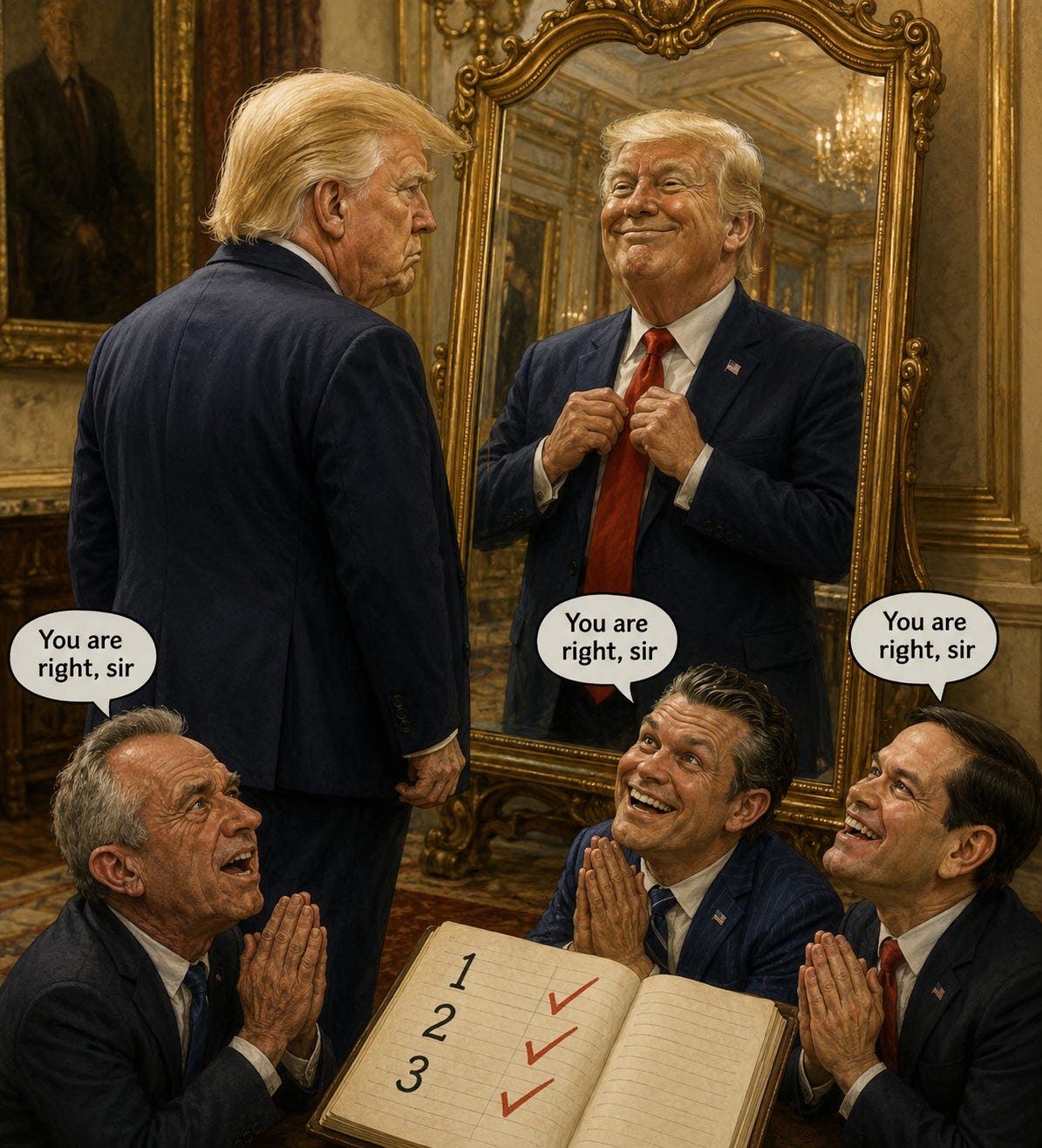
The first sign is always the circle. A leader who is losing the thread begins, quietly and then obviously, to narrow the range of people whose counsel he trusts. Advisors who deliver unwelcome assessments are replaced. Critics are reframed as enemies. The inner circle contracts until it contains only those who reflect the leader’s existing convictions back at him, polished and amplified.
Lyndon Johnson offers the clinical case. By 1967, with nearly half a million American troops in Vietnam and the war visibly unwinnable, Johnson had reduced his decision-making to a small Tuesday lunch group whose primary qualification was agreement. Intelligence reports contradicting the official line were discounted. Analysts who raised doubts found themselves less frequently in the room. The result was a White House operating on a version of the war that bore increasingly little resemblance to the war being fought.
Kaiser Wilhelm II of Germany ran the same play on a grander stage. His own chancellor described his governing style as “personal rule” — a system in which the machinery of state existed primarily to confirm what the emperor already believed. Advisors who pushed back were replaced. Those who remained learned to agree. The foreign policy that followed — erratic, antagonistic, strategically purposeless — reflected not German interests but Wilhelm’s unfiltered instincts, uncorrected by anyone with the standing or courage to correct them.
The current case: by his second term, the pattern of departures from Trump’s inner circle had become one of the most documented phenomena in modern American political history. Those who left — or were removed — shared a common characteristic: at some point, they had said something true that he did not want to hear. Those who remained shared a different characteristic. The circle contracted. It is still contracting.
Characteristic Two: The Unfalsifiable Narrative
The second sign is the story that cannot be wrong. In every documented case of presidential or executive disconnection, the leader constructs a narrative about himself and his situation that is structurally immune to disconfirmation. Evidence that supports the narrative is amplified. Evidence that contradicts it is reframed as fabricated, conspiratorial, or the product of enemies.
Woodrow Wilson, incapacitated by a massive stroke in October 1919, continued to believe — even as his left side lay paralyzed and his wife managed the executive branch in his name — that he retained the vigor to seek a third term. He was not informed of the full extent of his own condition. But the more instructive detail is that Wilson, even before the stroke, had displayed a rigidity of conviction that his biographers describe as a lifelong characteristic: he was constitutionally unable to acknowledge that he might be wrong about something he had decided he was right about. The League of Nations failed in part because Wilson refused to accept the Senate’s proposed modifications. He would have it whole or not at all. He got not at all.
The pattern appears, with variations, across the historical ledger. Nicolae Ceaușescu of Romania governed for twenty-four years inside a narrative in which the Romanian people adored him, the economy flourished, and opposition was the work of foreign agents. When the crowd booed him from the balcony of the Central Committee building in December 1989 — the first time in a quarter century that reality had penetrated the performance — his face went blank. He had no framework for it. The story had no category for a crowd that booed.
The current case presents a version that is, historically speaking, unusually pure. The 2020 election was not lost; it was stolen. The January 6th proceedings were a witch hunt. Every court that ruled against him was corrupt. Every poll that showed unfavorable numbers was rigged. Every institution that delivered unwelcome findings — the intelligence services, the Department of Justice, the Federal Reserve — was weaponized. The narrative is total. It is also, structurally, unfalsifiable: any evidence against it becomes, by definition, further evidence of the conspiracy it posits.
Characteristic Three: Grandiosity as Governing Philosophy
The third characteristic is the conflation of self with state — the genuine belief that the leader’s instincts, preferences, and personal interests are identical to the national interest, and that actions serving one necessarily serve the other.
George III of England provides the most familiar version of this in its clinical form — a king whose periodic madness expressed itself partly as an inability to distinguish his own will from divine mandate. This creates a psychological framework to what modern historians recognize as a tragic, legitimate medical crisis. While he was politically stubborn regarding the American colonies, his famous bouts of "madness" are widely attributed to severe mental illness (like bipolar mania) or the metabolic disorder porphyria. But the more useful comparison is again Wilhelm II, whose grandiosity was not pathological but dispositional: he genuinely believed, as a matter of settled conviction, that his personal judgment was sufficient to govern an empire, that expertise was for people who lacked confidence, and that the role of institutions was to execute his vision rather than to check it.
Richard Nixon, in his final months, demonstrated what this characteristic looks like under pressure. Nixon’s paranoia — his certainty that enemies surrounded him, that the press was conspiring against him, that loyalty to the country and loyalty to Nixon were interchangeable concepts — had been a feature of his personality long before Watergate. Secretary of Defense James Schlesinger who, in the final days of August 1974, quietly instructed the Joint Chiefs of Staff that any unusual military or nuclear orders from the White House must be cleared through him first and took quiet steps to ensure that military orders in those final weeks would not be executed without independent verification. The military had inserted a check on the commander in chief. It should not have been necessary. It was.
The current case: the use of the pardon power to benefit personal associates, the pressure applied to the Justice Department on behalf of personal legal interests, the characterization of prosecutions as persecution, the claim — stated plainly and repeatedly — that a president should be immune from legal accountability for official acts. These are not aberrations. They are the logical expression of a governing philosophy in which the president and the presidency are understood to be the same thing.
The Ledger
Across these cases — Wilson, Johnson, Nixon, Wilhelm, Ceaușescu, and the broader historical catalogue — three characteristics recur with enough consistency to constitute a pattern: the shrinking circle, the unfalsifiable narrative, and the conflation of self with state.
The current case presents all three, simultaneously, at a scale and duration that is, in the American context, without precedent. Wilson had one of the three, situationally. Johnson had two, temporarily, and ultimately blinked. Nixon had two, chronically, and was removed by the system before the third fully metastasized.
What makes the present moment historically distinct is not the characteristics themselves — those are old. What is new is the sequence: these characteristics were publicly documented, at length and in detail, before the election. Twice. The electorate, having reviewed the evidence, rendered a verdict. This shifts the historical question from the leader to the system that produced him — and to the rest of us, who are the system.
That is the more interesting question. It is also the more uncomfortable one.
The enlightened cynic notes it, and moves on.
FTS
Join us on our podcast the Enlightened Cynic, where satire meets substance and storytelling sparks civic engagement. Each episode dives into topics like authoritarianism, political spectacle, environmental justice, humor, history and even fly fishing and more—layered with metaphor, wit, and historical insight. We feature compelling guest interviews that challenge, inspire, and empower, especially for senior audiences and civic storytellers. Listen to the audio on all major podcast platforms, watch full video episodes on YouTube, or explore more at our website.
Let’s keep the conversation sharp, smart, and unapologetically bold
