America First, or America at All?
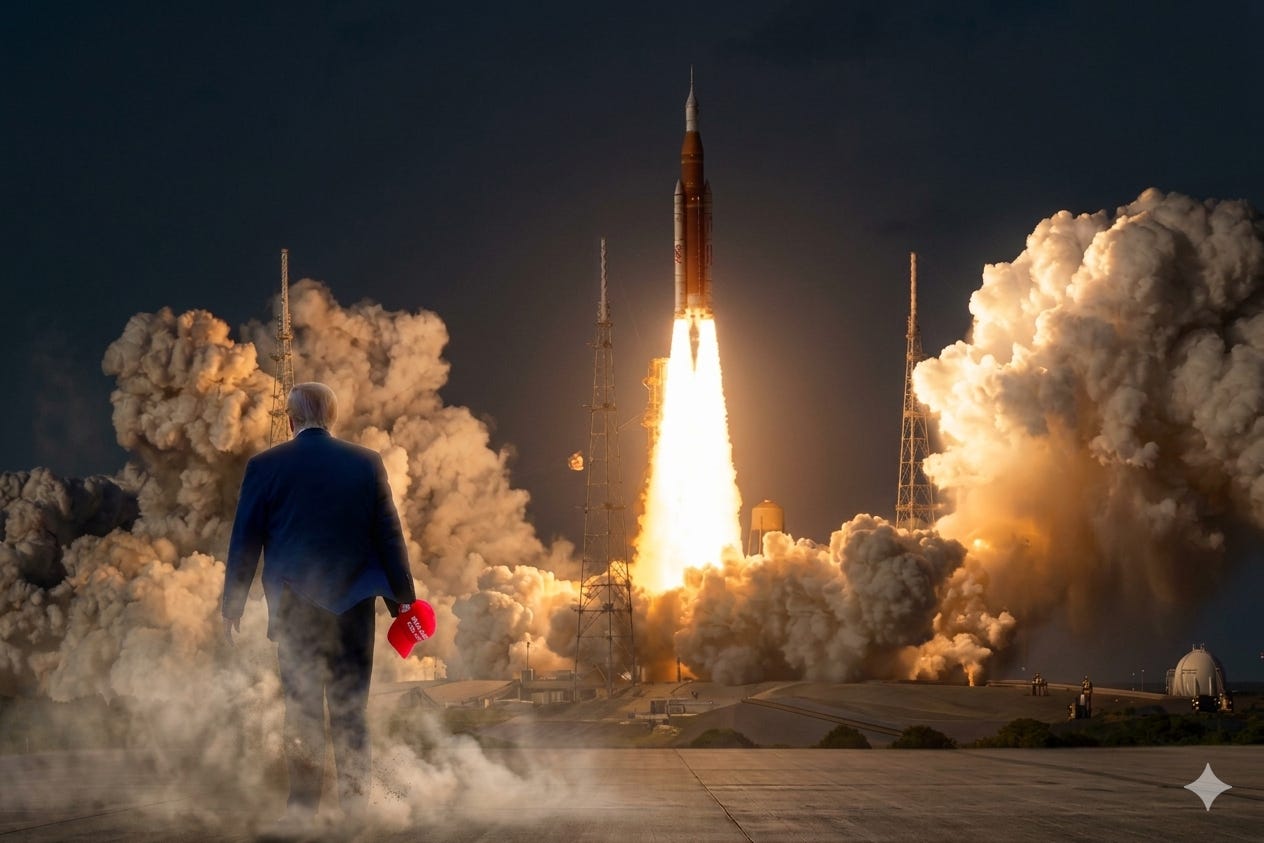
Trump Is Racing to Redefine ‘America First’ in a Time of War
Washington has been debating the thrust of Mr. Trump’s foreign policy for more than a decade, with the only consensus being that “America First” means whatever the president says it does.
New York Times April 10, 2026
1,050 words 5 min read
There is a phrase that has been weaponized so thoroughly, repeated so insistently, and emptied so completely of meaning that it now functions less as a policy position than as a kind of political tone poem — the verbal equivalent of a flag pin worn by someone who has never asked what the flag actually means. “America First.” The current occupant of the White House has made it the organizing principle of a foreign policy the New York Times describes, with admirable restraint, as whatever the president says it is on any given morning.
The phrase has a history that its current champion appears indifferent to. It has a content problem: if everything is first, nothing is. It has, most damningly, a competitor — one that has been quietly, methodically, and at enormous human cost defining what “first” actually looks like, not in a press release, but in orbital mechanics.
The Artemis program — battered, delayed, over budget, politically inconvenient, and still determinedly pointed at the Moon — has built a working vocabulary of “first” that has the distinct advantage of being verifiable. The Space Launch System (SLS) is the most powerful rocket ever flown. The Orion capsule will carry human beings farther from Earth than any crewed spacecraft since Apollo 17 in 1972. The crew selected for Artemis II included, for the first time in history, a woman and a person of color assigned to a lunar trajectory. These are firsts in the only sense the word has ever actually mattered: nobody had done it before, and then somebody did.
WHAT ARTEMIS HAS ALREADY DEFINED AS “FIRST”
The record here is not rhetorical — it is physical, dated, and still warm from re-entry. Artemis I, launched in November 2022, was uncrewed by design: a 25-day proof-of-concept that sent the Orion capsule on a sweeping arc around the Moon and 268,563 miles from Earth — farther than any spacecraft built for humans had previously traveled — before splashing down in the Pacific. It was the dress rehearsal.
Artemis II was the performance. Launching April 1, 2026, it was the first crewed flight beyond low Earth orbit since Apollo 17 in 1972 — a gap of 54 years. Over ten days, commander Reid Wiseman, pilot Victor Glover, and mission specialists Christina Koch and Jeremy Hansen flew Orion — christened Integrity — on a free-return arc around the far side of the Moon, passing within 4,067 miles of the lunar surface before gravity slung them back toward home. On April 6, on the sixth day of flight, they did something no human being had ever done: they traveled 252,756 miles from Earth, breaking Apollo 13's record of 248,655 miles — a mark that had stood for 56 years, set not by triumph but by catastrophe, by three men trying desperately to get home alive. Artemis II broke it on purpose, in full health, with room to spare.
The crew carried history in every seat. Victor Glover became the first person of color to travel beyond low Earth orbit. Christina Koch became the first woman. Jeremy Hansen became the first non-American. Commander Wiseman became the oldest person to travel to the Moon's vicinity. Behind all of them stood tens of thousands of engineers, technicians, and scientists — many of them women, many of them first-generation Americans — whose names will never trend, whose work cannot be undone by a single executive order, and whose definition of "first" was never up for debate.
The contrast with the political usage is not merely rhetorical. It is structural. Political “firsts” are asserted; scientific ones are demonstrated. A president can declare that America is first in strength, first in resolve, first in whatever the teleprompter requires today. The rocket either lifts off or it doesn’t. The heat shield either holds or it doesn’t. The splashdown coordinates are either accurate or the capsule is lost. Nature, unlike a cable news chyron, does not negotiate.
What makes the current president’s use of this phrase particularly hollow is not political disagreement — it is communicative collapse. Watch the press conferences. Read the transcripts without mercy. What you encounter is a man who cannot sustain a grammatical sentence about a complex subject for longer than thirty seconds before the thought loses its footing and falls into repetition, grievance, or a pivot to crowd size. He cannot describe, with any precision, what America being “first” would actually look like — what it would require, what it would cost, what would have to be built or sacrificed or sustained over decades. He speaks in the vocabulary of dominance without any of its grammar. He asserts without reasoning, brags without specification, threatens without strategy. For a man who holds the most consequential office on Earth — the one person on the planet with the authority to reshape alliances, deploy force, and define the terms of global engagement — this is not a stylistic quirk. It is a governing incapacity.
The cognitive decline is visible and it is not partisan to say so. Neurologists who study speech patterns have noted the compulsive repetition, the word-finding failures papered over with superlatives, the loss of narrative thread mid-sentence. “Many people are saying” is not a citation. “Believe me” is not an argument. “Like you’ve never seen before” is not a measurement. These are the rhetorical tics of a mind that has lost its grip on specificity — and specificity, it turns out, is the only thing that separates governance from performance.
Consider what it means that the people most rigorously, most verifiably pursuing American primacy are — almost by definition — the people least likely to use the phrase “America First.” The Artemis crew does not hold press conferences about winning. They hold press conferences about orbital insertion parameters. The engineers at Marshall Space Flight Center do not talk about beating China; they talk about propellant tank welding tolerances. The flight directors in Houston do not strategize about dominance; they run abort simulations until the abort is second nature. Not one of them has ever said “America First.” Every one of them has lived it.
This is not a coincidence. It reflects a deep truth about what excellence actually requires: the temporary, disciplined suspension of ego in service of a problem larger than any individual. The SLS did not get built by a man who needed to be the smartest in the room. It got built by thousands of people who needed to be right — which is a different thing entirely, and a vanishingly rare one in the current Washington climate.
An aging, narcissistic, medically compromised president who defines American greatness by the force of his assertion is not practicing a different theory of excellence. He is practicing the negation of excellence — the belief that saying a thing loudly enough is equivalent to making it true. This is a governing philosophy that works precisely as long as reality does not intervene. In domestic politics, reality can be deferred for some time. In orbital mechanics, it intervenes at roughly Mach 25.
The Artemis teams are not naive. They know the budget is insecure. They know that a change in political wind can reroute a program that took decades to build. They work anyway — because the Moon is there regardless of who is in the Oval Office, because the physics is the same under every flag, and because there is a word for the people who press on toward a goal that transcends the political moment.
The word is first.
The men and women of Artemis did not need a president to tell them what America is capable of. They already knew — and they proved it at 8.8 million pounds of thrust, at 268,563 miles from home, at the edge of a crater no human being has ever stood in. That is what first looks like. That is what it has always looked like. The rest is noise.
FTS