Could a President Be Forced to Resign Today?
Word Count: ~1,250 | Estimated Reading Time: 6–7 minutes
For many Americans, the memory of Richard Nixon’s resignation still carries a simple lesson: when wrongdoing becomes undeniable, a president is forced to step down. But that’s not what actually happened—and misunderstanding that moment leads to false expectations today. If there is any serious discussion about whether Donald Trump could ever be pushed to resign, it has to begin with a clear-eyed look at what really drove Nixon from office—and why those same forces are much harder to recreate now.
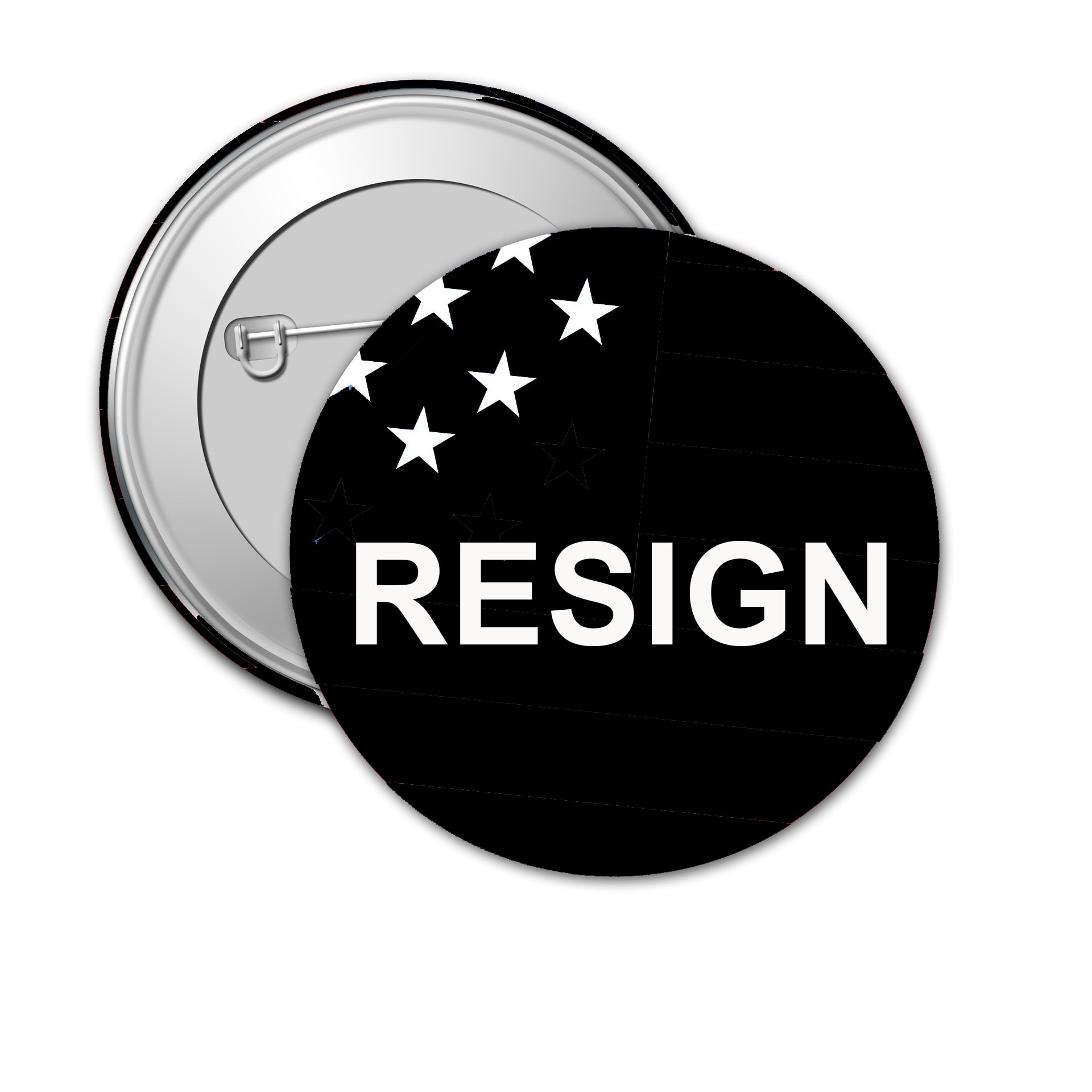
I began this line of thinking with a simple question: what if, instead of another “RESIST” movement, there were a serious push built around a single word—RESIGN—aimed at Donald Trump? At first glance, the idea has historical grounding. After all, a sitting president has resigned before. But as the logic unfolds, that initial premise runs into a much harder reality. The conditions that forced Richard Nixon from office were not simply about public pressure or even evidence of wrongdoing. They were structural, and those structures have changed in ways that make a similar outcome far more difficult to achieve today. So what began as a discussion about the possibility of a “RESIGN” campaign quickly becomes something else: an examination of why such a campaign would struggle to succeed, and whether a different kind of political shock—particularly a massive electoral upset—might instead create the internal rupture within a party that historically makes resignation possible.
The popular memory of Watergate is deceptively simple: a scandal emerges, evidence mounts, the public turns, and the president resigns. It is a clean and almost reassuring narrative. But it is incomplete. Nixon did not resign because people demanded it. He resigned because the political system around him collapsed, most importantly the support of his own party. The decisive moment came when senior Republican leaders, including Barry Goldwater, went to the White House in August 1974 and delivered a blunt assessment that had nothing to do with persuasion and everything to do with arithmetic: he no longer had the votes to survive. In the Senate, conviction required 67 votes. Nixon needed 34 senators to stand by him. He had, at most, a fraction of that. At that point, resignation was not a moral decision but a mathematical inevitability.
That moment has come to represent something larger—a kind of unwritten rule of American politics that might be called the Goldwater Effect. A president is only as secure as his party’s willingness to defend him. As long as that support holds, a president can withstand extraordinary pressure, including investigations, scandals, and even impeachment. Once it breaks, the collapse is swift. This is the central flaw in the idea of a modern “RESIGN” campaign. It assumes that pressure from outside the president’s party can force the outcome. History suggests otherwise. The decisive pressure is internal, not external.
There are several structural reasons why this dynamic is far more resistant today than it was in the 1970s. Party loyalty is more durable and more rigidly enforced. Where Nixon-era Republicans ultimately recalculated when he became a liability, today’s political environment creates powerful incentives to remain aligned. These include:
Primary elections dominated by highly partisan voters
Media ecosystems that reward loyalty and punish dissent
A political culture in which breaking ranks can end a political career
For many elected officials, opposing a president of their own party is more dangerous than defending him. This fundamentally alters the calculus that led to Nixon’s isolation.
At the same time, the constitutional requirement for removal—67 votes in the Senate—has become an even more formidable barrier in a closely divided and highly polarized chamber. Achieving that threshold would require a large bloc of the president’s own party to defect simultaneously, something that only occurs under conditions of extreme and immediate political risk. Without that risk, the numbers simply do not move.
Compounding this is the absence of a shared national “breaking point.” Watergate unfolded in a media environment where most Americans consumed the same information and, broadly speaking, reached similar conclusions about its meaning. Today, reality itself is fragmented:
Different audiences consume entirely different narratives
Evidence is interpreted through partisan frameworks
There is rarely a single event that produces consensus
Without a shared understanding of events, the kind of unified reaction that accelerated Nixon’s downfall becomes much harder to achieve.
If a single dramatic moment is unlikely to force change, what might? Modern political shifts tend to occur less through sudden revelations and more through accumulation—a slow grinding process in which conditions deteriorate in ways that people feel personally. These pressures include:
Economic strain that affects daily life
Administrative instability that erodes confidence
Prolonged conflict that drains public support
This is not a “big bang” moment but a gradual erosion, and it matters because it shapes the one factor that ultimately drives political survival: whether voters believe their lives are improving or getting worse.
This brings the discussion to a more plausible mechanism than a direct “RESIGN” campaign: a major electoral upset. If external pressure cannot directly force a resignation, a decisive election result can reshape the internal political landscape in which such a decision might occur. The historical parallel is instructive. In 1974, Republicans suffered significant losses in the midterm elections. Those losses did not remove Nixon, but they changed how Republican officials evaluated their own futures. They saw colleagues lose seats. They saw the damage spread beyond Washington. They began to imagine themselves as the next casualties. That shift in perception—not embarrassment—set the stage for the intervention by Goldwater and others.
It is tempting to believe that a president might resign to avoid humiliation or the diminished status of a lame-duck leader. But embarrassment has never been the driving force. Presidents step down when their ability to govern collapses, when their party withdraws support, and when their removal becomes unavoidable. A large electoral defeat can contribute to those conditions, but it does so indirectly by changing incentives, not by imposing shame.
This is where the importance of an overwhelming opposition vote becomes clear. Such a result does something that messaging or protest cannot: it converts dissatisfaction into measurable political risk. It answers, in concrete terms, the question every elected official must confront—whether continued alignment with the president threatens their own position. An electoral outcome of sufficient magnitude can:
Signal that the president’s coalition is weakening rather than holding
Undermine confidence that base support alone is sufficient
Create fear among incumbents about future elections
Shift the behavior of donors, party leadership, and institutional allies
In this sense, the importance of a large opposition vote is not symbolic. It is diagnostic. It reveals whether the existing political alignment remains viable.
Not every electoral loss produces this effect. For it to matter at the level of presidential survival, it must be interpreted as a structural warning rather than a routine shift. It must suggest that losses will continue, that the political environment has fundamentally changed, and that continued association carries increasing cost. Only under those conditions does the logic that confronted Nixon begin to re-emerge. Only then does the internal conversation within a president’s party shift from loyalty to risk management.
Even then, the modern political environment complicates the translation of electoral shock into party action. Safe districts reduce the personal risk for many lawmakers. Polarized media allows competing interpretations of results. Primary dynamics continue to incentivize alignment with core voters. These factors can blunt or delay the impact of even a significant defeat, making the pathway from election results to internal party rupture less direct than it was in 1974.
What began as a consideration of a “RESIGN” campaign ultimately leads to a more grounded conclusion. Presidents are not forced out by slogans or even sustained external pressure. They are forced out when their own party concludes that the cost of defending them exceeds the cost of letting them go. An overwhelming electoral rejection can accelerate that conclusion, but it cannot substitute for it.
The lesson of 1974 is not that public pressure alone can remove a president. It is that public sentiment must translate into political risk that alters the behavior of those in power. Nixon’s fall came when those forces aligned—when the electorate, the evidence, and the incentives of political elites all pointed in the same direction. Any modern parallel would require the same convergence. Not just opposition, but opposition large enough to change the internal math of power. That remains the defining constraint—and the central reality—of presidential survival today.
The only question that remains is who is today’s Barry Goldwater?
FTS
Join us on our podcast Specifically for Seniors, where satire meets substance and storytelling sparks civic engagement. Each episode dives into topics like authoritarianism, political spectacle, environmental justice, humor, history and even fly fishing and more—layered with metaphor, wit, and historical insight. We feature compelling guest interviews that challenge, inspire, and empower, especially for senior audiences and civic storytellers. Listen to the audio on all major podcast platforms, watch full video episodes on YouTube, or explore more at our website.
Let’s keep the conversation sharp, smart, and unapologetically bold