Hiding in Plain Sight
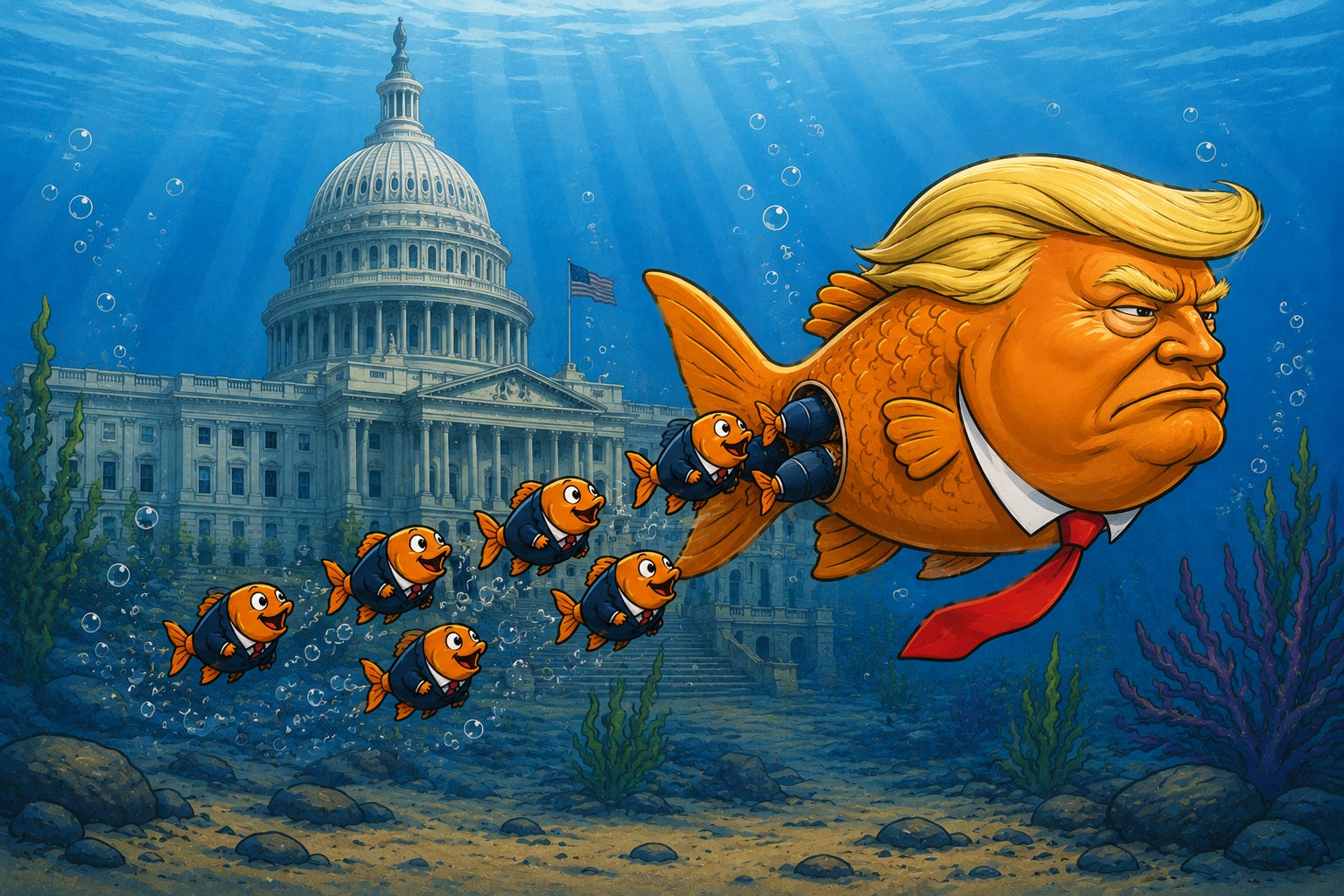
A Fish That Hitches Rides Where the Sun Doesn’t Shine
When danger calls, some animals bare their teeth. Others take to the sky, or curl into protective balls. But the remora — a fish that often hitches a ride on larger marine animals like sea turtles, whales and sharks — sometimes follows a less dignified strategy: It disappears inside a manta ray’s rear end.
In a study published on Monday in the journal Ecology and Evolution, a team of researchers referred to this newly observed behavior as “cloacal diving.” While many questions about this fishy practice remain, there is one thing the team feels sure about.
New York Times May 11, 2025
740 Words 4 minute reading time
Sometimes writing this Substack is way too easy, and perhaps — as a matter of simple dignity — I shouldn’t even touch it. But here we are.
A study published May 11th in the peer-reviewed journal Ecology and Evolution has confirmed what the New York Times was only too happy to summarize for general audiences: the remora fish has been documented crawling headfirst into a manta ray’s backside. Repeatedly. Across multiple ocean basins. Over fifteen years. The behavior has a clinical name — “cloacal diving” — which is science’s way of dressing up something genuinely astonishing in a dinner jacket. The cloaca, for the uninitiated, is a one-stop-shop orifice used for reproduction and excretion. The remora has decided this is prime real estate. CBC Radio
Researchers documented seven observations spanning all three currently described manta ray species, in both juvenile and adult hosts, across multiple ocean basins. The remoras are, as study co-author Emily Yeager noted, “pretty much as wide as the cloaca is — fully filling that opening.” Scientists suspect the behavior is far more common than the data shows, noting that “oftentimes you just see the very tip of the tail poking out from the backside of the manta ray. They’re really wedging themselves into that area.” A moderately-sized remora lodged there for an extended period, the researchers warn, could potentially impede mating, live birth, or defecation. Wiley Online Library + 3
The manta ray, to its considerable credit, finds none of this agreeable. In one video, a manta ray shuddered visibly after a remora entered its cloaca. In other observations, the rays flicked their pectoral fins in what scientists believe was an attempt to dislodge the intruder. Senior study author Catherine Macdonald put it with admirable economy: “It does not look like the manta ray likes it.” SciencexYahoo!
Here is where the analogy to the current Congress both clarifies and — in one crucial respect — diverges.
The manta ray objects. It shudders. It flicks. It retains, somewhere in its elegant cartilaginous frame, a vestigial sense that something has gone deeply wrong. Donald Trump has displayed no such reflex. There is no shudder. There is, if anything, a velvet rope and a guest list. Where the manta ray endures cloacal diving as an indignity, Trump has made cloacal kissing — let us call it what it is — a prerequisite for admission to the court. He doesn’t merely tolerate the behavior. He has institutionalized it. He grades the performances. He rewards the most committed practitioners with access, with endorsements, with the all-important social media post that signals continued favor.
And the Republican Congress has been an eager student of the form.
What we have watched since January 2025 is a legislative body that has not merely tolerated the executive’s appetites — it has serviced them. Tariffs that economists across the ideological spectrum called reckless were waved through without serious debate. Pete Hegseth, Matt Gaetz, and Tulsi Gabbard — nominees of staggering unsuitability — were confirmed or celebrated with barely a murmur of principled resistance. Oversight investigations were quietly buried. The power of the purse — Congress’s most fundamental constitutional authority, the one the Founders considered so essential they put it first — was cheerfully surrendered to DOGE, an unelected operation with no statutory basis, and the members whose institutional power was being dissolved applauded on their way out the door.
The compliments, meanwhile, have grown baroque. Grown men and women who once called this president a threat to democracy now compete to describe him in terms that would embarrass a greeting card. Each declaration of loyalty must be a little louder, a little more untethered from observable reality, than the last. It is, in its way, a remarkable performance art — the competitive self-erasure of an entire branch of government.
But here the analogy to the remora breaks down entirely, and not in Congress’s favor. The remora has traditionally been understood to provide something in return — a cleaning service, picking parasites off its host’s skin. The relationship, however invasive, carried biological logic. There was reciprocity, however assymmetric (misspelling intentional) Congress has abandoned even that. It has performed the cloacal diving without the cleanup. It has delivered the devotion while systematically failing to exercise the oversight, the legislative independence, and the institutional self-preservation that might justify its existence as a co-equal branch. It goes in. It stays in. It offers nothing in return except its own compliance. Live Science
The manta ray shudders and flicks and carries on, magnificent and aggrieved.
The other one just asks for more.
FTS
Join us on our podcast the Enlightened Cynic, where satire meets substance and storytelling sparks civic engagement. Each episode dives into topics like authoritarianism, political spectacle, environmental justice, humor, history and even fly fishing and more—layered with metaphor, wit, and historical insight. We feature compelling guest interviews that challenge, inspire, and empower, especially for senior audiences and civic storytellers. Listen to the audio on all major podcast platforms, watch full video episodes on YouTube, or explore more at our website.
Let’s keep the conversation sharp, smart, and unapologetically bold
