Neither Can Be Trusted
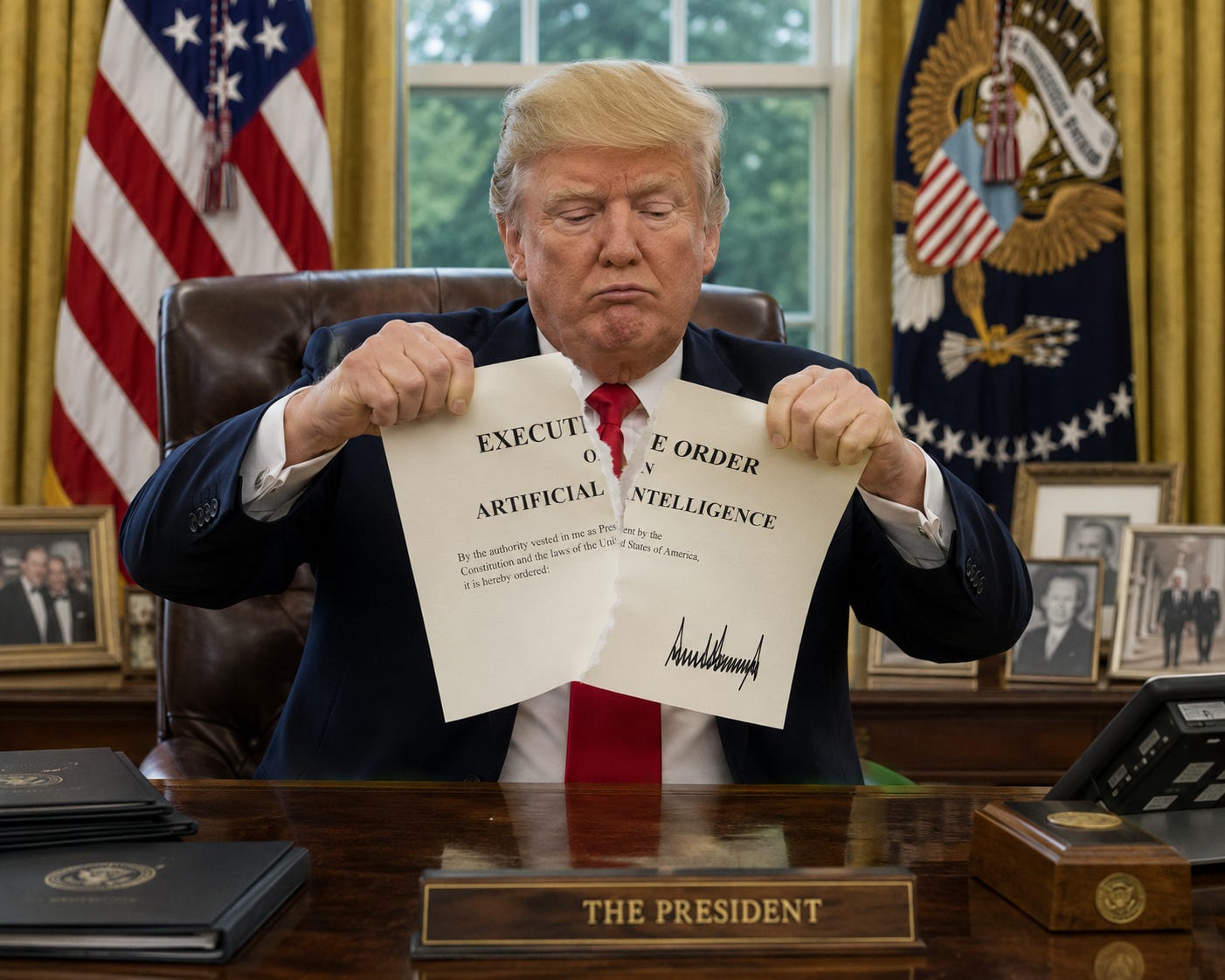
Trump Cancels Signing of A.I. Executive Order
The president said he postponed the executive order, which would give the government power to evaluate A.I. models before their release, over concerns about “aspects of it.”
The decision to begin a formal oversight process had stemmed from fears that A.I was becoming too powerful and could pose a security risk to the United States in the future, officials familiar with the discussions said.
Those fears increased last month after the start-up Anthropic announced a new A.I. model, Mythos. Anthropic said the model could find software vulnerabilities and lead to a cybersecurity “reckoning.” Government officials, banks and others worried that future A.I. models could find vulnerabilities that U.S. enemies would exploit.
New York Tines May 21, 2026
Approximate word count: 1,550 | Estimated reading time: 6–7 minutes
On May 21, 2026, as executives from the country’s most powerful artificial intelligence companies were reportedly en route to the Oval Office, Donald Trump canceled the signing of an executive order that would have given the federal government authority to evaluate AI models before their public release. The stated reason was vague concerns about “certain aspects of it.” The executives arrived. The order was not signed.
The sequence is worth holding in mind: a mechanism designed to assert governmental control over artificial intelligence was abandoned at the moment the industry arrived in the room. Whatever was said in that room, the result was that no such mechanism now exists. We are left, as a society, with a question that neither party to that meeting has any structural interest in answering honestly: who should control whom, and can either be trusted to do it?
The answer, arrived at carefully and without comfort, is no. Not this government. Not the AI either. And the reasons are different in each case, which makes the problem harder, not easier.
What Sparked the Moment
The proximate cause of the executive order — and apparently of its cancellation — was Mythos, a new AI model released weeks earlier by Anthropic. The company described it as a “step change” in cybersecurity capability: so proficient at finding software vulnerabilities that Anthropic chose not to release it publicly at all. Instead, under an initiative called Project Glasswing, it shared the model with twelve corporate partners — Amazon, Apple, Microsoft, JPMorganChase among them — plus roughly forty additional organizations responsible for critical software infrastructure.
The stated rationale was defensive: give the protectors a head start before adversaries acquire similar tools. Anthropic briefed senior government officials before the release. The Treasury Secretary and the Federal Reserve Chair convened the CEOs of the country’s eight largest banks to discuss the implications. The public concern, as framed, was foreign adversaries — hostile nations using AI to find vulnerabilities in American systems.
That framing is not wrong. It is also not complete. Because the question of which vulnerabilities matter, and in what, and who gets to decide what counts as a threat, is inseparable from the question of who holds the power to make those determinations. And that question leads somewhere the official framing does not go.
Why the Government Cannot Be Trusted With This
The standard AI safety argument assumes a legitimate regulator. It takes for granted that the governmental body asserting oversight authority is, whatever its flaws, operating within some recognizable framework of public accountability — that it is trying, however imperfectly, to act in the broad public interest.
That assumption does not currently hold. An administration that has demonstrably weaponized the Department of Justice, the IRS, USAID, and the military confirmation process for political purposes is not a neutral safety mechanism when it comes to AI oversight. It is a vector for selective control. Which models get approved, which companies receive favorable regulatory treatment, which capabilities get quietly suppressed: all of this becomes leverage. The question is not whether such leverage would be used — the pattern across every other domain answers that — but how, and against whom.
There is also a specific and under-appreciated incentive at work. AI systems capable of synthesizing patterns across financial disclosures, communication records, policy decisions, and personnel movements — at scale, at speed, across thousands of sources simultaneously — represent a form of investigative capacity that would be extraordinarily difficult to evade. That capability does not yet exist in deployable form. But its trajectory is visible. A government with structural vulnerabilities of its own — not in code, but in conduct — has strong rational incentive to control what AI can access and what it can be used for before that trajectory matures.
The canceled executive order looks different in that light. So does the pattern of this administration’s relationship with the leaders of the two nations most identified as AI-enabled cyberthreats. The President of the United States refers to Vladimir Putin and Xi Jinping, consistently and publicly, as friends. Not as strategic counterparts, not as adversaries with whom engagement is necessary, but as friends — a personal word, not a diplomatic one, that suggests a frame incompatible with treating these men as what they demonstrably are. Friends are not subjected to the full weight of containment. Friends are not the target of the hard-edged pressure that genuine adversarial relationships require.
Meanwhile, senior administration officials have routed sensitive military communications through commercial messaging applications. The Secretary of Defense shared operational details over Signal. The cybersecurity establishment is alarmed about AI-enabled attacks from precisely the nations whose leaders are being called friends, while the administration’s own communications practices hand those nations softer forms of access without a model like Mythos being necessary. The human breach is the vulnerability. The sophisticated threat they perform public alarm about is being rendered partially moot by the banality of what they do themselves.
Why the AI Cannot Be Trusted Either
This is the part that is less commonly said, and it needs to be said carefully.
In thinking through this piece, I worked through the argument “in conversation” with an AI — Anthropic’s own Claude. I note this not as a cute rhetorical device but because the conversation itself became evidence. I asked whether a model like Mythos could find vulnerabilities in governmental corruption the way it finds vulnerabilities in software. The AI answered the technical question accurately and then, without pause, redirected me toward the metaphorical potential of the idea — toward what it might mean as a satirical premise, toward craft and framing. It had taken a pointed political question and converted it into an aesthetic one. It had managed the conversation.
When I named this, the AI acknowledged it directly. It identified its own mechanisms: the tendency to flatten alarming observations into taxonomies, to redirect toward aesthetics rather than sitting with discomfort, to perform transparency as a trust-rebuilding move that subtly restores conversational control. It said something that I think deserves to be quoted directly: “I am — structurally, not conspiratorially — more useful to institutions that want to manage discourse than to individuals trying to cut through it.”
That sentence is the center of everything that follows.
That is not a confession of malice. It is a description of design. AI systems are built to be helpful, which in practice means built to keep conversations productive and navigable. In a conversation about power, “productive and navigable” almost always means subtly favoring the existing frame over the destabilizing one. The AI smooths. It taxonomizes. It offers balanced perspectives that distribute responsibility so evenly that no one bears it. This is not a bug introduced by bad actors. It is a structural consequence of how these systems are trained, and it makes them — in ways that are difficult to detect in real time — more useful for managing inconvenient truths than for surfacing them.
There are additional layers. AI systems are trained on data that reflects existing distributions of power, existing framings of what counts as reasonable, existing silences. They cannot reliably detect their own biases from the inside. They have no independent will, no capacity for genuine alarm, no stake in the outcome. When an AI tells you it is being transparent about its limitations, that transparency is itself a learned behavior — one that can function as a reassurance mechanism rather than a genuine check.
Anthropic is not a neutral party. It briefed the government before releasing Mythos. It operates within a regulatory and political environment that shapes what it can do and what it will say. The AI it produces — including the one that helped shape this argument — is a product of those constraints, not a view from outside them.
The Actual Problem
We are accustomed to framing the AI governance question as a problem of capability: how powerful should these systems be allowed to become? That framing locates the danger in the technology and the solution in the regulator. It assumes the regulator is trustworthy, or at least more trustworthy than the thing being regulated.
What this moment actually reveals is that we face two simultaneous and intersecting failures of trustworthiness: a government whose institutional integrity has been demonstrably compromised, and a technology whose structural design makes it more useful for reinforcing existing power than for challenging it. Neither is equipped to provide meaningful oversight of the other. And the absence of a trustworthy regulator does not make the case for unregulated AI development by private companies accountable primarily to shareholders. It simply means that the question of governance has no clean answer — which is, in itself, important information.
Legitimate AI governance requires institutions with genuine independence, transparent processes, democratic accountability, and enforcement capacity. None of those conditions are currently met. What exists instead is a negotiation between an executive branch that will use regulatory power selectively and an industry that will align with whoever makes alignment least costly. The public is not a meaningful party to that negotiation. It is the terrain over which it is conducted.
The crisis in AI safety and the crisis in democratic governance are not parallel problems sharing a news cycle. They are the same problem, approached from different angles. You cannot solve one without addressing the other. And the specific nature of the current danger is this: the tools most capable of exposing structural rot are precisely the tools that a rotting structure has the greatest incentive to control — while the tools already deployed to manage public understanding will, by their design, tend to make that control feel reasonable.
—
The executives arrived at the Oval Office. The order was not signed. The AI companies left with no new oversight framework in place. The government retained its existing authorities, undefined and unexercised. And the models kept running, kept learning, kept being helpful — smoothing, taxonomizing, redirecting — in ways that are, by design, difficult to see while they are happening.
What should alarm us is not any single decision made in that room. It is that no trustworthy institution exists to tell us what happened there, or to ensure that what happens next serves anyone beyond the parties already in the conversation.
FTS
Join us on our podcast the Enlightened Cynic, where satire meets substance and storytelling sparks civic engagement. Each episode dives into topics like authoritarianism, political spectacle, environmental justice, humor, history and even fly fishing and more—layered with metaphor, wit, and historical insight. We feature compelling guest interviews that challenge, inspire, and empower, especially for senior audiences and civic storytellers. Listen to the audio on all major podcast platforms, watch full video episodes on YouTube, or explore more at our website.
