THE $250 QUESTION: RUTABAGA OBTAINS RIVAL DESIGN FOR TRUMP CURRENCY
Before we begin — a word about this publication. The Enlightened Cynic is free, and it will stay that way. These conversations are too important to put behind a paywall. But free doesn’t mean costless to produce, and independent voices don’t get heard simply by existing — they get heard when enough people are paying attention. But numbers matter. Subscribers are how Substack’s algorithm notices a publication, how other readers find us, and how an independent voice earns the standing to be heard beyond its current circle. One click. No charge. Considerable difference.
Trump appointees push $250 banknote with his portrait
The director of the printing bureau, Patricia “Patty” Solimene, and other staff repeatedly explained to Beach and Brown that there were legal and procedural obstacles to producing the note and that it would take years longer than they envisioned, the four employees said.
The two political appointees were dismissive in response, two of the current employees said.
“She had told them we’re not authorized to do this. We can’t progress any further, and all the stakeholders have not even met to discuss the next steps,” said one of the employees. “Currency often takes six to eight years to produce a new bill, particularly one of such high value.”
Solimene said she was abruptly reassigned from her post by Treasury management on April 27, writing the next day in an email to colleagues that she was leaving with a “heavy heart.” She wrote in her goodbye email, a copy of which was obtained by The Post, that she had been reassigned to another job in the Treasury Department and that her departure was “not my choice.”
Washington Post May 28, 2026
Word count: approximately 700 words. Estimated reading time: 2.5 minutes.
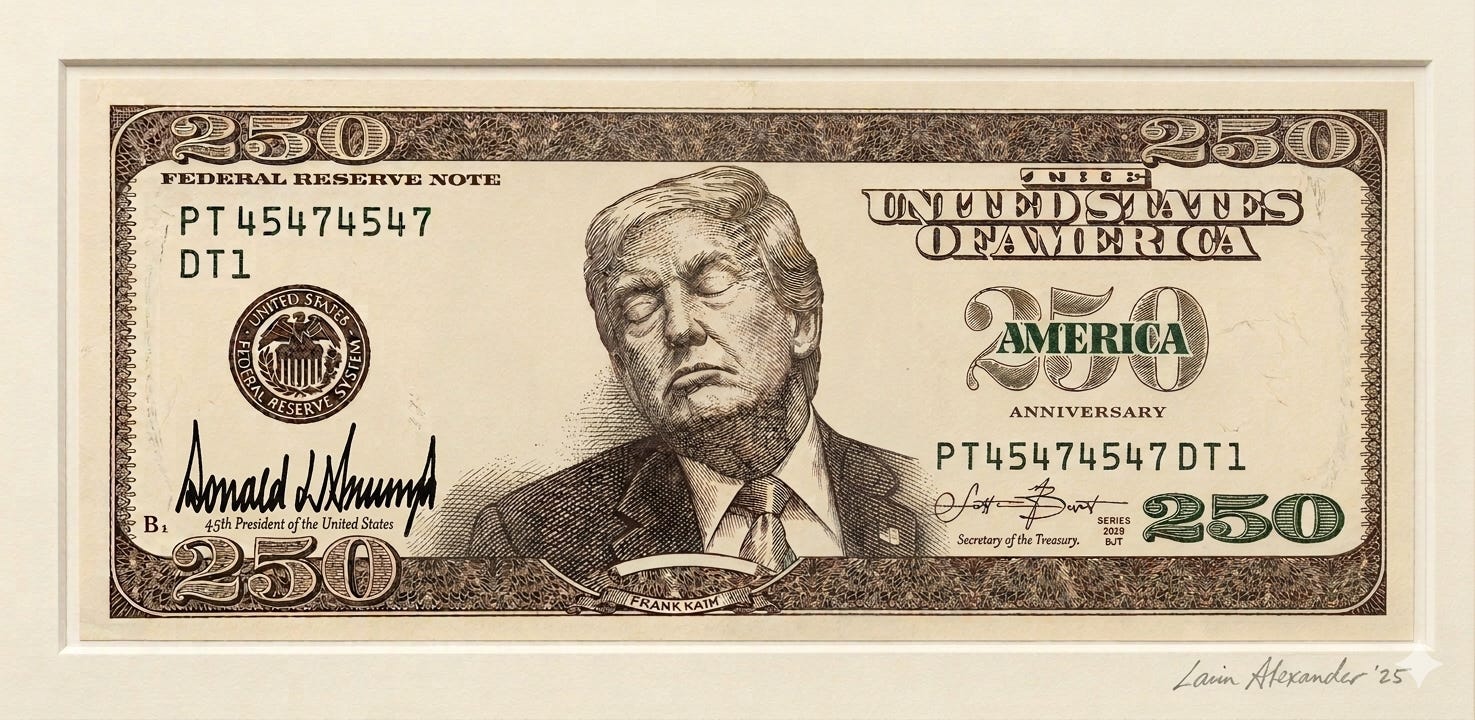
WASHINGTON — As the Trump administration continues its vigorous campaign to place the president’s image on American currency, The Rutabaga has obtained an alternative design for the proposed $250 bill (shown above) — one that, sources close to the project say, captures its subject with considerably greater fidelity than the official mock-up circulated by Treasury officials pictured here.
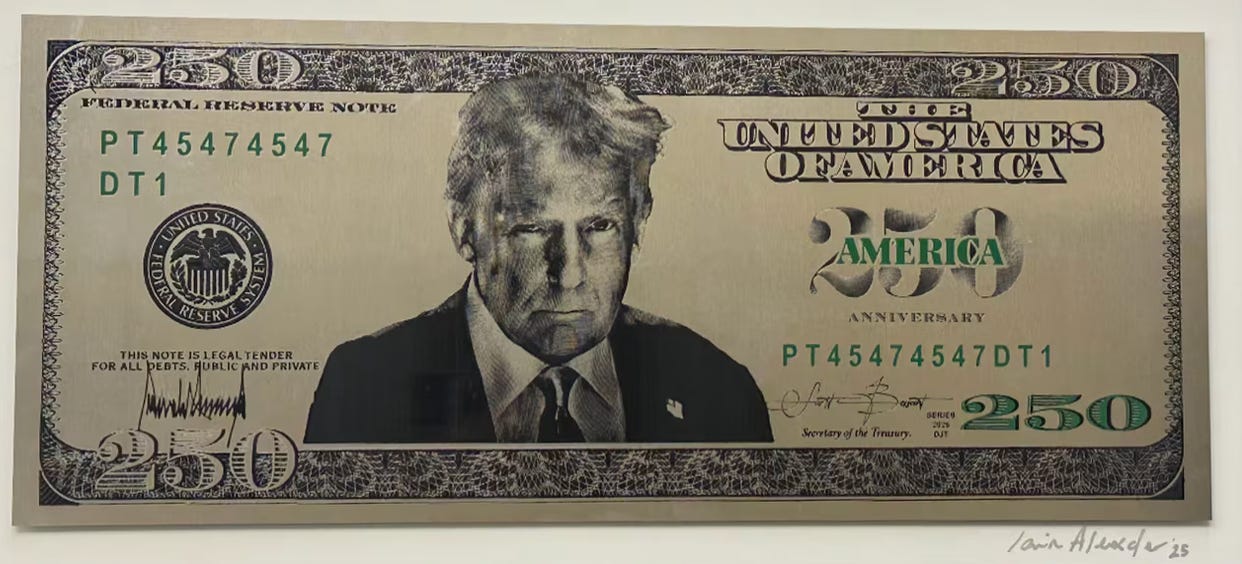
The competing design, also attributed to Alexander and bearing the serial number PT 45474547 DT1 — a sequence that currency historians note encodes, with touching literalness, the numbers 45, 47, and the initials DT — depicts President Trump in what the artist describes as “a moment of serene, almost regal repose.” Others have used different words. “He looks like he fell asleep at the closing of a very good real estate deal,” said one Bureau of Engraving and Printing employee who requested anonymity because they still need their paycheck.
The portrait shows the president with eyes at half-mast, chin elevated, expression hovering somewhere between profound contemplation and the final moments before a nap that no one is allowed to mention is happening. Art critics have called it “luminous.” Treasury officials called it “not what we asked for.” The president himself has not commented, possibly for reasons the portrait makes self-evident.
A SMALL LEGAL MATTER
There is, admittedly, one minor procedural obstacle to the $250 Trump bill, which careful readers of federal statute may have noticed: it is, at present, illegal.
United States law currently stipulates, with the kind of tedious specificity that has long made lawyers unpopular at parties, that only deceased individuals may appear on American currency — a restriction first enacted in 1866 after a mid-level Treasury bureaucrat named Spencer Clark had the audacity to put his own face on a 5-cent note, thus establishing, in one hubristic act, both the problem and its remedy.
The president is, as of press time, alive. This is generally considered a point in his favor, though it does complicate the currency question. A separate statute specifies which denominations the Bureau of Engraving and Printing is authorized to produce, and “$250” does not appear on that list, presumably because no one previously felt the need to make change for it.
Treasury officials note that legislation has been introduced in Congress to address both problems simultaneously. Which brings us to Congress.
THE LEGISLATIVE PROCESS, SUCH AS IT IS
The bill in question — formally titled the Make America’s Wallet Great Again Commemorative Currency and Presidential Glorification Act, though The Rutabaga may have taken slight liberties with the name — was introduced last year to coincide with the nation’s 250th anniversary. It has, in the understated phrasing of the Washington Post, “languished.”
This has not deterred Treasury Treasurer Brandon Beach and his senior adviser Mike Brown, who have reportedly pressed bureau staff to begin prototype work immediately, legal authorization being, in their view, more of a suggestion than a prerequisite. Patricia Solimene, the bureau’s director and a 24-year Army veteran, repeatedly explained that currency production typically takes six to eight years and that the relevant stakeholders had not even convened to discuss next steps. She was reassigned on April 27th. Brown has since been named acting director.
“The buck stopped here,” Solimene wrote in her farewell email to colleagues, in what will stand as the most precisely deployed pun in the history of federal bureaucratic correspondence.
Sources on Capitol Hill say they are “cautiously optimistic” that enough members of Congress can be located who are willing to vote for a bill honoring the president, a search that neutral observers have likened to finding enough people willing to accept free pizza.
THE SERIAL NUMBER
The Rutabaga notes, for the record, that the serial number on the competing design — PT 45474547 DT1 — contains within it the complete numerical biography of the 45th and 47th President of the United States, rendered in intaglio on a note that is not yet legal, in a denomination that does not yet exist, bearing the image of a man who is not yet eligible to appear on it.
In this, our sources suggest, it may be the most perfectly Trumpian object ever created: boldly announced, technically unauthorized, and somehow already signed.
FTS
Join us on our podcast the Enlightened Cynic, where satire meets substance and storytelling sparks civic engagement. Each episode dives into topics like authoritarianism, political spectacle, environmental justice, humor, history and even fly fishing and more—layered with metaphor, wit, and historical insight. We feature compelling guest interviews that challenge, inspire, and empower, especially for senior audiences and civic storytellers. Listen to the audio on all major podcast platforms, watch full video episodes on YouTube, or explore more at our website.
