The Audition Ends Without Applause
Is Budapest the bellwether?
Two Hungary scenarios with major implications for the United States
… On Tuesday, Vice President JD Vance flew to Budapest to campaign for Orbán. Behind the seal of the vice presidency, Vance implored Hungarians not to oust their leader for the sake of “western civilization.”
MICHAEL ANGELONI AND BEN RADERSTORF
If You Can Keep It April 10, 2026
and
Iran War Live Updates: U.S. and Iran Hold Historic High-Level Peace Talks
American officials, led by Vice President JD Vance, met with senior Iranian negotiators, U.S. and Iranian officials said. It was the highest-level face-to-face meeting between the countries since Iran’s 1979 Islamic Revolution.
New York Times April 11, 2026
Approximately 1,650 words | 7 minute read
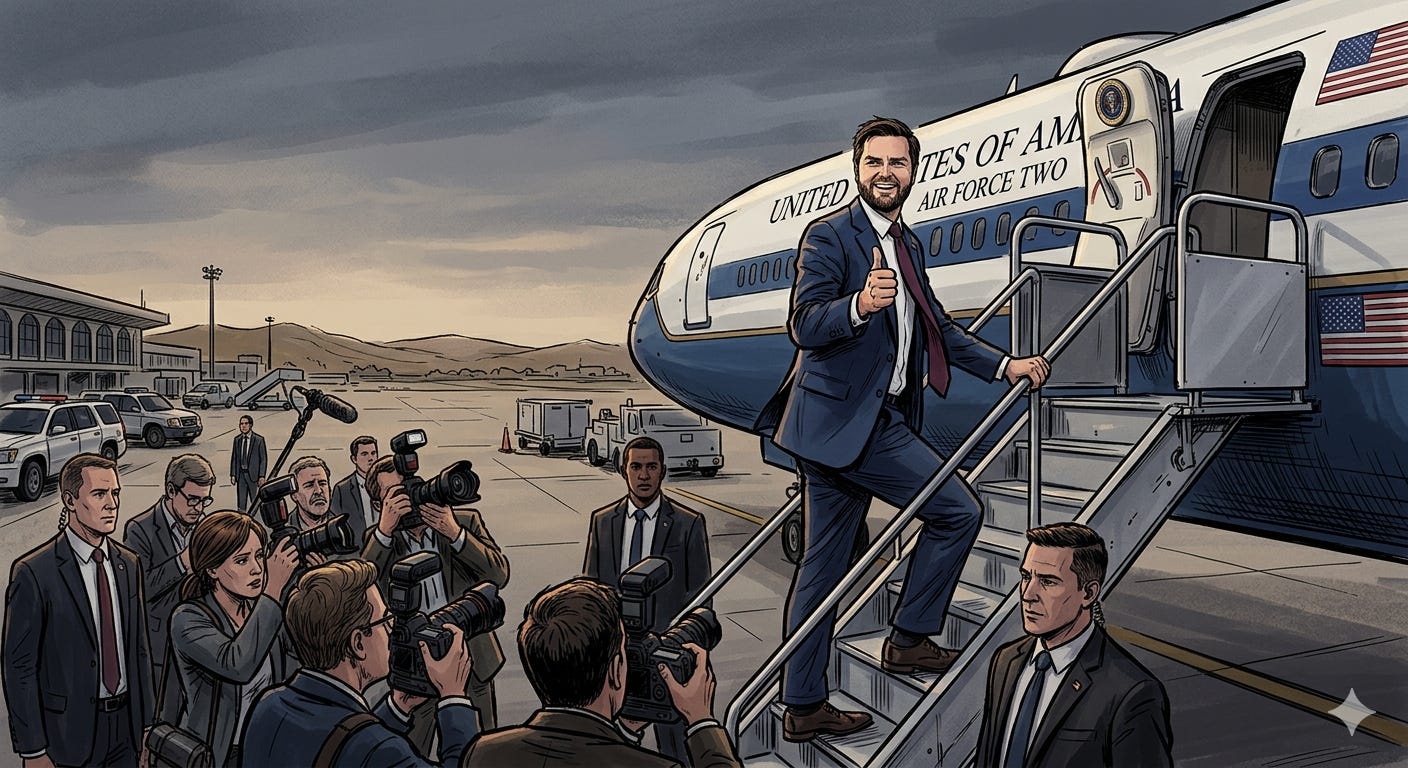
He gave a thumbs up boarding Air Force Two.
That image — JD Vance, departing Islamabad after 21 hours of failed negotiations, flashing a thumbs up at cameras — may be the most telling moment of the entire enterprise. The talks had collapsed. The ceasefire’s future was suddenly uncertain. Iran’s delegation was already telling state media that the United States had been “looking for an excuse to leave.” And the vice president of the United States, heading home without a deal to end a war that has killed more than 5,600 people, offered the cameras a thumbs up.
It was the gesture of a man who had already decided how this was going to play.
What Happened in Islamabad
The United States and Iran failed to reach an agreement after a day of highly anticipated face-to-face peace talks. “The bad news is that we have not reached an agreement,” Vance told reporters. “I think that’s bad news for Iran much more than it’s bad news for the U.S.”
The talks lasted about 21 hours. Vance said his group — which included senior White House envoy Steve Witkoff and the president’s son-in-law Jared Kushner — were returning to the U.S. without conducting a second session. “We’ve made it very clear what our red lines are, what things we’re willing to accommodate them on, and what things we’re not willing to accommodate them on, and they have chosen not to accept our terms,” Vance said.
The two sides were simply too far apart — not just in substance, but in style and temperament. Vance appeared to be after a relatively quick solution, but Tehran typically moves much slower, negotiating over the long term.
Iran’s parliamentary speaker Mohammad Bagher Ghalibaf, who led the Iranian delegation, said his country came with goodwill but that the U.S. “was not able, in this round of negotiations, to gain the trust of the Iranian delegation.”
The thumbs up notwithstanding, the structure of the failure was entirely predictable. It had been predicted here, before Vance ever boarded the plane.
The Setup — and the Transaction
Vance did not want this war. That much is documented — and carefully so, in ways that suggest deliberate intent. Before Trump ordered the first strikes on February 28th, Vance raised concerns inside the administration, privately and in the deniable language of someone positioning himself without breaking ranks. He was the anti-interventionist wing of an administration that chose intervention.
Trump acknowledged they were “philosophically different.” He went ahead anyway. And Vance — loyal, disciplined, strategically patient — went along, said nothing publicly, let others own the war, and absorbed none of its political cost.
Six weeks later, Trump needed someone to end it. He chose the man who had quietly opposed it from the start. That is not irony. It is alignment — a transaction between a president who needed a peacemaker and a vice president who needed a stage.
The Calculation That Corrupts
What was happening in Islamabad was described as diplomacy. It was that — but it was also something else.
Vance’s presence was not primarily about Iran. It was about 2028. His brand — skeptical of foreign wars, the voice of the working-class Midwest against imperial misadventure — had become awkward inside an administration that launched an air war in the Middle East. Islamabad was where that contradiction was supposed to get resolved. Analysts in his orbit said it plainly: “There’s almost no risk.” If talks succeeded, he was the statesman who ended a war he never supported. If they failed — well, Iran walked away.
The thumbs up was the tell. It was the gesture of a man executing the second scenario with the same equanimity as the first.
But there is a cost to this kind of calculation that gets measured somewhere other than polling data. Performance is a corrupting force in negotiation. When the lead negotiator’s most important audience is not the party across the table but voters watching from home, every decision acquires a second layer. What will this look like? How will this be received? What can be conceded without appearing to concede?
Those are different questions from the one diplomacy is meant to answer: what does the other side actually need?
What Iran Actually Needed
Iran’s demands were not opening gambits. They were the accumulated grievances of a country bombed twice by a government it had watched tear up a signed agreement once already.
Tehran wanted durable sanctions relief. It insisted on its right to civilian nuclear enrichment. It wanted binding guarantees — not promises from a president who might be replaced or reversed — that it would not be attacked again. It wanted Lebanon’s ceasefire explicitly included. It wanted recognized sovereignty over the Strait of Hormuz. And it wanted reparations — full financial compensation for the economic destruction inflicted since February 28th. The UN has assessed regional economic losses at $63 billion. Iran’s new Supreme Leader stated it directly: “We will not leave the criminal aggressors who attacked our country alone.”
A U.S. official had called the full list “ridiculous and unrealistic.” But here is what makes it something more than that: the United States bombed a country that its own intelligence assessed had not decided to build a nuclear weapon. Iran was maintaining nuclear latency — the capacity to build quickly, without having pulled the trigger. That is a meaningful distinction, and it is the distinction the original nuclear agreement was specifically designed to manage.
The reparations demand is politically impossible in Washington. It is morally coherent in Tehran. And that gap — between what Iran says it needs to trust a deal and what any American politician seeking higher office can credibly offer — was never going to be closed in 21 hours by a vice president running for president.
The Deal That Was Already There
This is the fact that should never be allowed to recede into background noise: there was already an agreement.
In 2015, after twenty months of professional multilateral diplomacy, the Obama administration reached the JCPOA with Iran. It worked. Iran surrendered 97 percent of its enriched uranium, dismantled two-thirds of its centrifuges, filled its plutonium reactor with concrete, and accepted IAEA inspectors with authority to demand access to any suspicious site at any time. Iran’s nuclear breakout time extended from two or three months to at least twelve. Over 28 months in force, the IAEA reported no significant violations.
Trump withdrew the United States from it in 2018.
The sanctions campaign that followed destroyed Iran’s economy and freed its nuclear program from all constraints. Iran’s stockpile grew toward weapons-grade territory. The IAEA formally declared it noncompliant. And still, by the administration’s own intelligence assessment, Iran had not decided to build a weapon. It was hedging — and that hedge was what the JCPOA had been built to contain through transparency rather than force.
The question Vance brought to Islamabad is the same one answered in Vienna in 2015. It arrived now wrapped in rubble, reparations demands, a closed strait, and a two-week ceasefire whose future, as of Sunday morning, no one could clearly describe. The first time, it took twenty months and professional diplomats with institutional knowledge and the full weight of the international community behind them. The second time, it was given to a real estate envoy, a president’s son-in-law, and a vice president with a 2028 campaign to protect — and a deadline of one day.
The Budapest Problem, Confirmed
Before Vance flew to Islamabad, he flew to Budapest to praise Viktor Orbán — the leader he and others in his ideological circle have held up as a governing model. Strong executive authority. Weakened institutional checks. A foreign policy that treats democratic commitments as transactional rather than principled. Orbán has cultivated relationships with Russia, China, and Iran, while systematically dismantling the courts, press, and civil society structures that constrain executive power.
Iran’s parliamentary speaker, in his statement after the talks collapsed, said the issue was trust. The United States had not been able to earn it. That is a diplomatic assessment. It is also a more pointed observation than it appears. When you are asking a government — one that watched the United States break its last signed agreement — to extend trust, the company you keep in the days before you arrive matters. The worldview you carry into the room matters.
Vance’s worldview is coherent. It is also one in which institutions are obstacles, commitments are contingent, and strength is the only currency that reliably holds value. Iran’s negotiators understood who was across the table.
The Bill
Here is the full accounting. A working nuclear agreement existed. The first Trump administration tore it up. Iran’s program grew unconstrained. This administration launched a war to destroy what its own policy had cultivated — and its own intelligence said Iran hadn’t decided to build a weapon. More than 5,600 people are dead. The region has absorbed $63 billion in economic damage. The Strait of Hormuz remains contested. The ceasefire is fragile.
And the man sent to resolve it flew home with a thumbs up and a “final and best offer” left on the table — which is another way of saying no offer at all.
The people dying in Lebanon, counting dead in Iran, watching oil prices spike — they are not participants in JD Vance’s political narrative. They are its cost.
The bill has not been paid. It has been deferred. And deferred bills, in this part of the world, have a way of coming due with interest.
Sources: NPR, NBC News, CNN, Al Jazeera, Bloomberg, The National, CBS News, ABC News, The New York Times, Council on Foreign Relations, Center for Arms Control and Non-Proliferation, UK House of Commons Library, RAND Corporation, FactCheck.org, “Is Budapest the Bellwether?” — Michael Angeloni and Ben Raderstorf (If You Can Keep It, April 10, 2026)
FTS
Join us on our podcast Specifically for Seniors, where satire meets substance and storytelling sparks civic engagement. Each episode dives into topics like authoritarianism, political spectacle, environmental justice, humor, history and even fly fishing and more—layered with metaphor, wit, and historical insight. We feature compelling guest interviews that challenge, inspire, and empower, especially for senior audiences and civic storytellers. Listen to the audio on all major podcast platforms, watch full video episodes on YouTube, or explore more at our website.
Let’s keep the conversation sharp, smart, and unapologetically bold