The Boulder That Never Reaches the Top
8 min read~1,650 words
Before he was condemned to his famous commute, Sisyphus was, by ancient Greek standards, a fairly admirable scoundrel. He cheated death twice, outwitted the gods, and was generally the sort of person who, in a later era, would have a podcast, a line of steaks, and a complicated relationship with the truth. The gods eventually tired of him and assigned him his eternal task: roll a boulder up a hill. Watch it roll back down. Repeat until the stars go cold.
Albert Camus, writing in Nazi-occupied Paris in 1942, looked at this punishment and had a peculiar response. He called it the human condition. The boulder, he argued, is consciousness itself — our relentless need for meaning in a universe constitutionally indifferent to the request. The hill is existence. And the rollback? That’s just Tuesday.
His radical conclusion, the thing that made philosophers spill their coffee across two continents, was this: we must imagine Sisyphus happy.
I have been thinking about this a great deal lately. Not because I have developed a sudden taste for French existentialism (though I’m open to the possibility - Les Jeux Sont Faits), but because the myth of Sisyphus maps onto a particular strain of contemporary American political life with an accuracy that would be comic if it weren’t so exhausting.
The original myth, briefly
The structure of the Sisyphus story is elegant in its cruelty: an impossible task, performed in full sincerity, forever thwarted at the moment of completion. The gods did not condemn Sisyphus to failure. They condemned him to almost. The boulder gets close. It always gets close. And then gravity, that most democratic of forces, does what gravity does.
Camus’s genius was to reframe this not as tragedy but as a kind of freedom. Sisyphus, he argued, owns his fate by seeing it clearly. He has no illusions about the gods or the summit. He knows the boulder will roll back. And in that knowledge — not despite it but because of it — he finds something the gods cannot take from him: the life between the attempts.
“The struggle toward the heights is enough to fill a man’s heart.” Camus wrote that. Nietzsche, had he lived to see cable news, might have added a footnote. That footnote would read: "...provided the struggle is not against an outrage-driven, 24-hour cycle of manufactured dread—in which case, the ascent is no longer heroic, but simply an exercise in subsidizing the abyss."
The MAGA myth
Now. Let us talk about a different boulder.
The MAGA movement is, at its core, a mythology — and I use that word descriptively, not dismissively. All political movements run on narrative. This one runs on a particularly potent and ancient variety: the restorationist myth. There was a golden age. It was stolen. A chosen figure has returned to reclaim it. The enemies are real, named, and must be defeated. Victory is always just over the hill.
You find this structure everywhere humans have organized themselves around grievance and hope. It’s in religious apocalypticism, in nationalist movements, in half the fairy tales your grandmother told you. The details change. The deep grammar doesn’t.
In the MAGA version: America was great. Then it wasn’t, through a complex conspiracy of elites, globalists, coastal condescension, deep state machinations, and possibly the cast of The View. Donald Trump arrived — was sent, in some tellings — to push the boulder back to the top. The summit is variously described as a nation with controlled borders, resurgent manufacturing, diminished “wokeness,” and a general atmosphere of national confidence, which is a harder thing to legislate than it sounds.
Where the myths converge
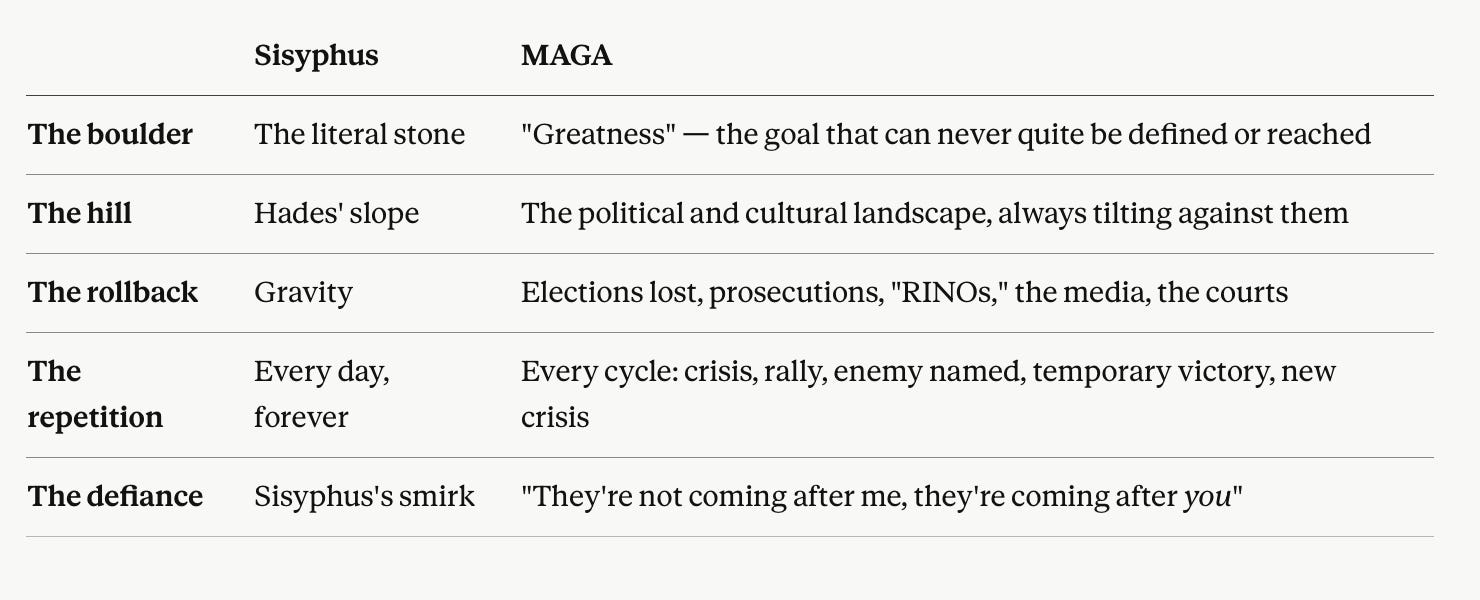
The crucial parallel is this: in both cases, the boulder never actually reaches the top — and that is not a bug. It is the engine. MAGA’s political energy depends entirely on the restoration being perpetually deferred. A fully “won” movement would have no movement left. The swamp must remain, in some meaningful sense, un-drained. The enemies must keep conspiring. The summit must stay tantalizingly close but never achieved, because achievement would end the story, and the story is the point.
Every rollback, in this mythology, is recast as sabotage — which preserves the faith and, not incidentally, the fundraising.
The key difference: consciousness
Here is where Camus gets genuinely useful, rather than merely decorative.
His Sisyphus is lucid. That is the whole point. He sees the structure of his situation with absolute clarity — the condemned man who has made peace with his sentence by understanding it completely. His happiness is not denial. It is philosophical self-possession. He knows the boulder will roll back, and he goes to retrieve it without illusion.
The MAGA myth operates on the precisely opposite epistemological premise. Its power comes from sincere belief that the summit is reachable — that this time, the right enemies will be named and vanquished, the right executive orders signed, the right man empowered. The rollback is never attributed to the structure of the hill. The rollback is always someone’s (Sleepy Joe) fault.
Camus’s Sisyphus would be a terrible MAGA voter. He’d see through the whole architecture in about twenty minutes and wander off to contemplate the Mediterranean. Which, to be fair, sounds like a reasonable response to most things.
Trump as the boulder
I want to propose a slight amendment to the standard casting.
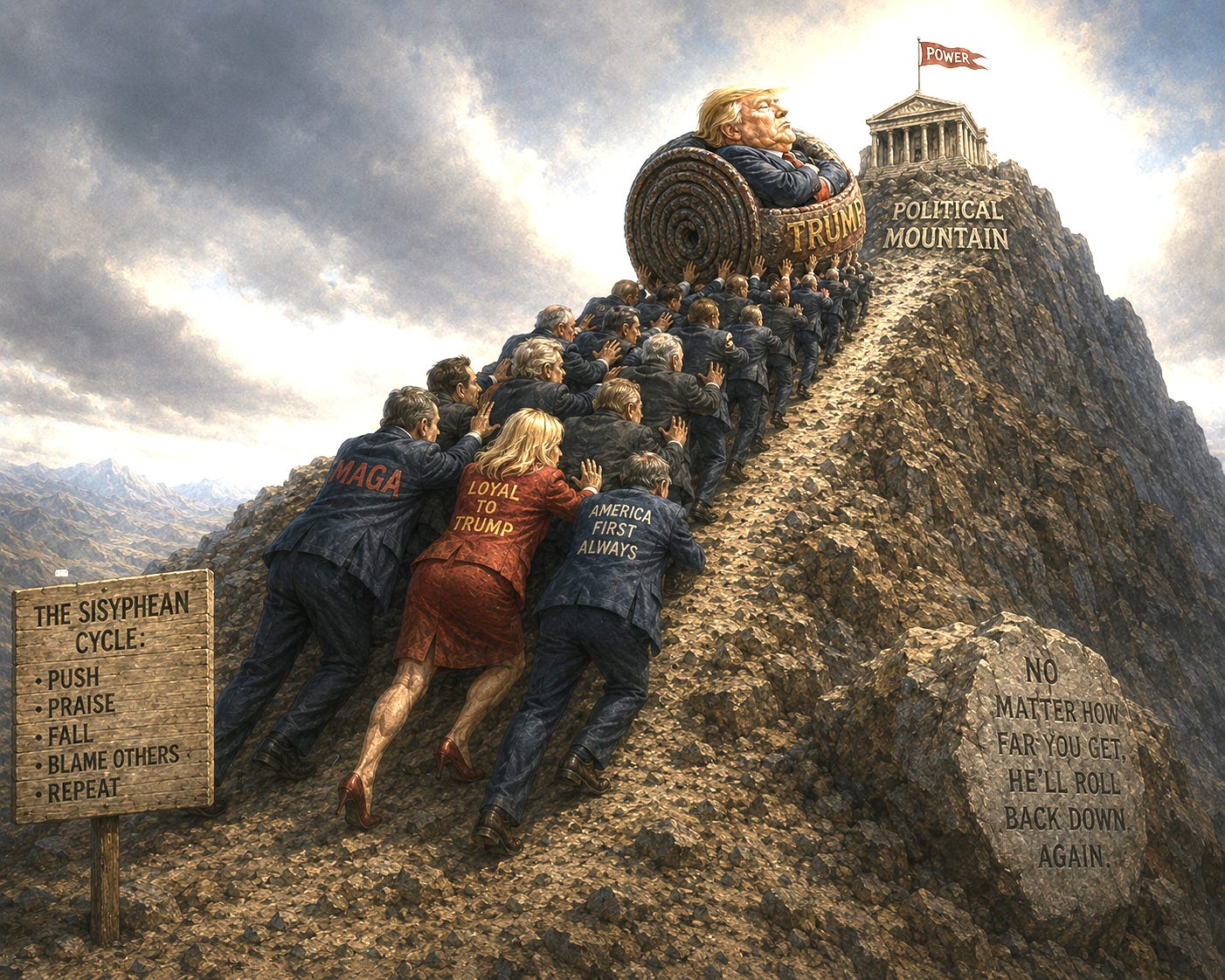
Trump is not Sisyphus in this story. He is the boulder. He is large, dense, requires enormous collective effort to push uphill, generates considerable chaos on the way back down, and somehow always ends up at the bottom again — ready to be pushed once more, apparently none the worse for the journey.
His supporters are the Sisypheans. They are doing the actual labor, with the actual devotion, with the actual blistered hands. And unlike Camus’s hero, they are not invited to find meaning in the striving itself. They are told, at every rally, that the summit is right there. Just one more push. The media is lying to you about how close you are. Keep pushing.
Camus would find this tragic. He had a word for accepting false hope as a substitute for clear sight: philosophical suicide. It is, he argued, just another way of refusing to look at the hill.
The absurdist punchline
There is something Camus understood about the human animal that the architects of the MAGA myth also understand, but deploy differently. We cannot live without meaning. We will construct it, import it, defend it, and die for it. The question is not whether we will reach for a narrative — we will, all of us, always — but whether the narrative we choose requires us to be permanently betrayed in order to hold together.
The gods condemned Sisyphus to push the boulder. He found freedom anyway, in the clarity of his own seeing.
The question Camus might ask of our current moment — and it is not a partisan question, it is a philosophical one — is simpler and more uncomfortable than any ballot measure: who told these people the summit was within reach?
And what did they get for telling them that?
FTS
Join us on our podcast the Enlightened Cynic, where satire meets substance and storytelling sparks civic engagement. Each episode dives into topics like authoritarianism, political spectacle, environmental justice, humor, history and even fly fishing and more—layered with metaphor, wit, and historical insight. We feature compelling guest interviews that challenge, inspire, and empower, especially for senior audiences and civic storytellers. Listen to the audio on all major podcast platforms, watch full video episodes on YouTube, or explore more at our website.
Let’s keep the conversation sharp, smart, and unapologetically bold
