The Coalition of the Willing
Part Four of Five: The Republic We Were Promised
Word count: 1,312 | Estimated reading time: 5 minutes
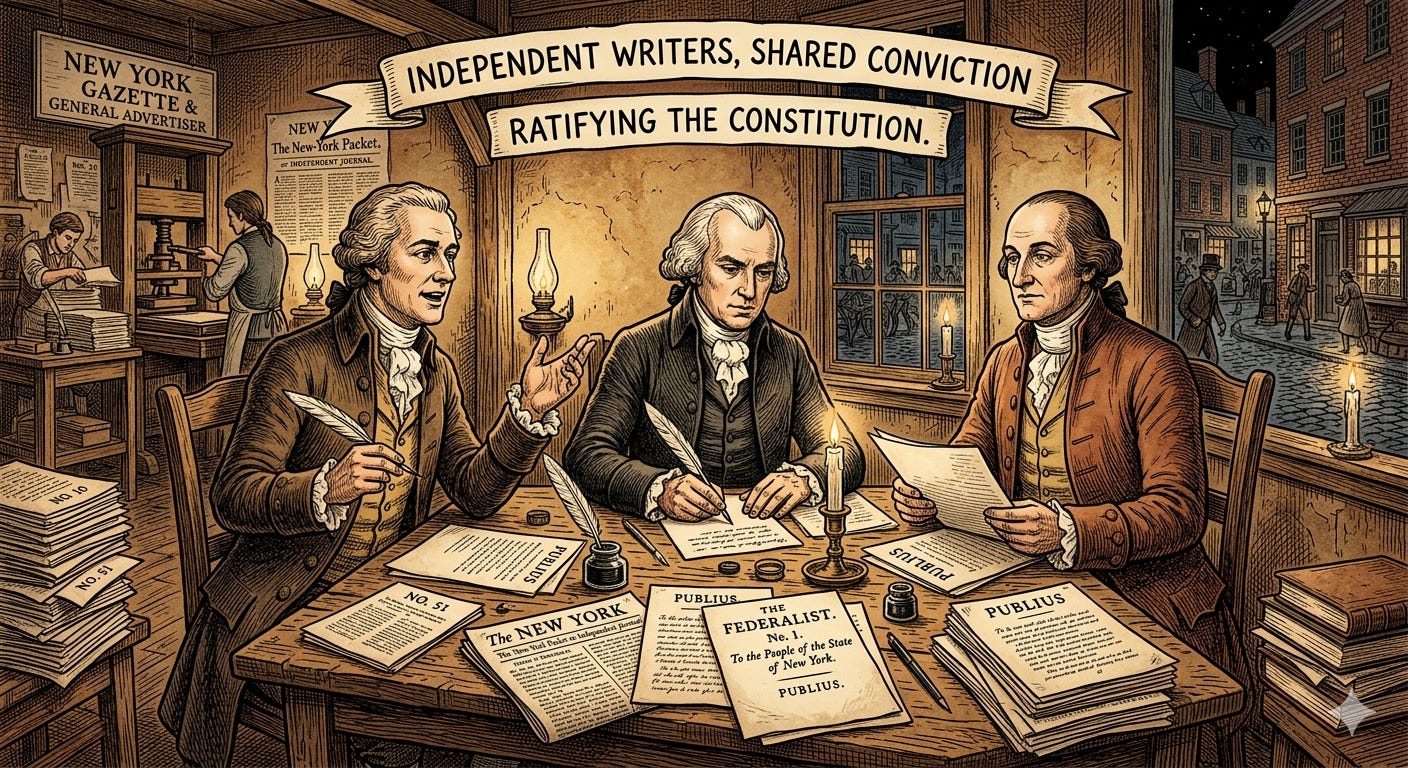
In 1787 and 1788, three men wrote eighty-five essays under a shared pseudonym and published them in New York newspapers to make the case for ratifying the new Constitution. Alexander Hamilton, James Madison, and John Jay were not a formal institution. They had no government backing, no official imprimatur, no guarantee that anyone would read what they wrote. They were, in the most literal sense, independent writers with a shared conviction and a coordinated publication strategy.
The Federalist Papers did not single-handedly ratify the Constitution. But they shaped the argument at the moment the argument needed shaping, and they have informed constitutional interpretation for two and a half centuries. The lesson is not that three writers can save a republic. The lesson is that coordinated intellectual effort, deployed at the right moment, can move things that institutional actors cannot or will not move.
We are at one of those moments. And the infrastructure for that kind of coordination has never, in the history of this republic, been more accessible.
What the Independent Press Actually Is Right Now
The landscape of independent journalism and commentary has changed more in the last decade than in the previous century. The collapse of local newspaper revenue, the fracturing of network media, and the rise of direct-to-reader platforms have simultaneously destroyed much of the institutional press and created something new in its place.
Substack alone hosts tens of thousands of writers, some of whom have built audiences that rival or exceed traditional publications. Podcasts reach audiences that would have required a national radio network to assemble twenty years ago. YouTube channels operated by individual journalists and commentators draw viewership that major cable news programs would envy.
These are not replacements for institutional journalism’s investigative infrastructure — the teams of reporters, the legal departments, the source networks that produce the Panama Papers or the Pentagon Papers. That infrastructure matters enormously and is genuinely endangered. But independent media does something that institutional media often cannot: it speaks without the constraints of corporate ownership, advertiser relationships, access journalism, and the institutional tendency toward false balance that presents two sides of every story even when one side is demonstrably lying.
The independent writer can say, plainly and without hedge, that a thing is false. That a person is lying. That an institution has failed. That the emperor has no clothes and here is a detailed accounting of his nakedness. This is not a small thing in an information environment where institutional caution has sometimes functioned as a kind of epistemic cowardice.
The Problem of Atomization
The limitation of the current independent media landscape is fragmentation. Ten thousand writers, each with their own newsletter, their own audience, their own brand, their own publication schedule, produce an enormous quantity of content and a relatively weak signal.
Readers who would benefit from the aggregate picture encounter individual pieces — good pieces, often excellent pieces — without the connective tissue that makes a movement rather than a cacophony. The writers amplify each other occasionally, on social media, when an algorithm rewards it. But the amplification is sporadic and reactive rather than strategic and sustained.
Meanwhile, the opposition information ecosystem — the one that sustains the cult dynamics described in the first installment of this series — is extraordinarily well coordinated. It has unified talking points, synchronized messaging, shared distribution infrastructure, and a clear chain of narrative authority running from a small number of sources outward to millions of consumers. It is, in information warfare terms, a much more disciplined operation than the fractured, individualistic landscape of independent democratic commentary.
The asymmetry is not absolute. The independent democratic press has advantages the authoritarian information ecosystem does not: it is substantially more accurate, it is more intellectually diverse, and it speaks to a citizenry that, in aggregate, has not fully abandoned the idea that facts matter. But accuracy and intellectual diversity are necessary conditions, not sufficient ones. They need to be organized.
What a Coalition Actually Looks Like
The model is not complicated. It has historical precedent. And the technology to execute it exists right now.
A coalition of independent writers and journalists operating in the democratic commentary space needs, at minimum, four things:
A shared identity larger than any individual voice. A name, a mission statement, a publication or platform that readers can follow as an entity rather than as a collection of individuals. The Federalist Papers worked partly because “Publius” was a brand. The coalition needs a brand — one that signals intellectual seriousness, editorial independence, and shared commitment to democratic norms without requiring ideological uniformity on every question.
Division of labor by strength. Reporters break stories. Essayists provide historical and analytical context. Legal writers explain what the rulings actually mean. Satirists — and this point deserves emphasis — make the ideas accessible and emotionally resonant for people who will not read a 3,000-word legal analysis but will share a piece that makes them laugh and think simultaneously. Each type of writer reaches a different audience and serves a different cognitive function. A coalition that deploys all of them in coordination is more than the sum of its parts.
Coordinated timing and amplification. Individual pieces disappear in the current information environment. Coordinated volleys don’t. When five writers address the same theme from different angles in the same week — one with reported facts, one with historical context, one with legal analysis, one with personal narrative, one with satire — it creates an information environment rather than a single article. Editors at institutional publications notice. Podcast producers notice. Readers feel the weight of convergence in a way they don’t feel a single piece.
Mutual support that goes beyond retweets. The writers and thinkers who oppose this administration face varying degrees of pressure — professional, social, sometimes legal. A coalition that pools resources for legal defense, that practices genuine solidarity when a member is targeted, that treats an attack on one as a matter of collective concern, is substantially more durable than a collection of individuals each managing their own exposure alone.
The Role of Satire — Specifically
A note on this, because it is undervalued in serious political commentary circles and it shouldn’t be.
Authoritarian movements are, at their core, projects of manufactured grandiosity. They depend on the leader appearing powerful, inevitable, chosen. The persecution narrative that sustains a cult following requires that the leader be simultaneously a victim and a titan — too important to be touched, too threatened to be safe.
Satire punctures this. It is not argument — it does not engage the movement on its own terms. It reframes. It makes the object of ridicule look small and ridiculous rather than powerful and threatening. It reaches people who are not reading political analysis, who are not engaged with the constitutional arguments, who are overwhelmed or exhausted or both — and it gives them a moment of recognition and release that keeps them connected to the reality the authoritarian movement is trying to obscure.
This is not a frivolous function. The court jesters of history understood something that the serious commentators sometimes miss: laughter is a form of resistance. Making people laugh at power is a way of reminding them that power is not invincible.
The coalition needs its satirists. Desperately.
The Stakes of Getting This Right
The free press — institutional and independent — is not just a check on power. It is the mechanism by which all the other checks are activated. Congressional oversight requires journalists to expose what Congress should be overseeing. Electoral accountability requires an informed citizenry, which requires information. Legal challenges require public understanding of what the legal issues actually are.
When the press fails — through capture, through cowardice, through fragmentation, through the economic destruction of local journalism — the other checks weaken with it. The relationship is not metaphorical. It is structural.
The coalition of independent writers and thinkers is not a substitute for institutional journalism. It is a supplement, a pressure source, and increasingly, a lifeline — carrying the argumentative and investigative burden in spaces where institutions are absent or compromised.
The writers reading this know who they are. The question is whether they will find each other, deliberately and strategically, and act like the coalition the moment requires — or continue to operate as talented individuals in separate rooms, doing important work that the information environment will not amplify into the force it needs to become.
The technology is there. The talent is there. The urgency is not in question.
What’s required is the decision to coordinate.
Next: Part Five — “The November Imperative” — Why the midterm primaries matter more than most people understand, and what it actually takes to build a voting coalition that can change the composition of Congress.
FTS
Join us on our podcast the Enlightened Cynic, where satire meets substance and storytelling sparks civic engagement. Each episode dives into topics like authoritarianism, political spectacle, environmental justice, humor, history and even fly fishing and more—layered with metaphor, wit, and historical insight. We feature compelling guest interviews that challenge, inspire, and empower, especially for senior audiences and civic storytellers. Listen to the audio on all major podcast platforms, watch full video episodes on YouTube, or explore more at our website.
