The Court That Couldn’t
Part Two of Five: The Republic We Were Promised
Word count: 1,287 | Estimated reading time: 5 minutes
There is a legal principle so fundamental that it predates the American republic by centuries: nemo iudex in causa sua. No one shall be a judge in their own cause. It is the bedrock of the idea that law means something — that it applies to the powerful as it applies to everyone else, that justice is not a preference but a constraint.
On July 1, 2024, the Supreme Court of the United States issued its ruling in Trump v. United States. The majority held that a president enjoys absolute immunity for core constitutional acts and presumptive immunity for all official acts. The dissent, written by Justice Sonia Sotomayor, was not subtle about what had happened. “The President of the United States,” she wrote, “is now a king above the law.”
The ruling did not come from nowhere. It came from a three-decade project, executed with discipline and patience by a legal and political movement that understood something the center-left did not: that the courts are where the long game is won.
Understanding how we got here is not an exercise in despair. It is a prerequisite for understanding what can still be done.
How You Capture a Court
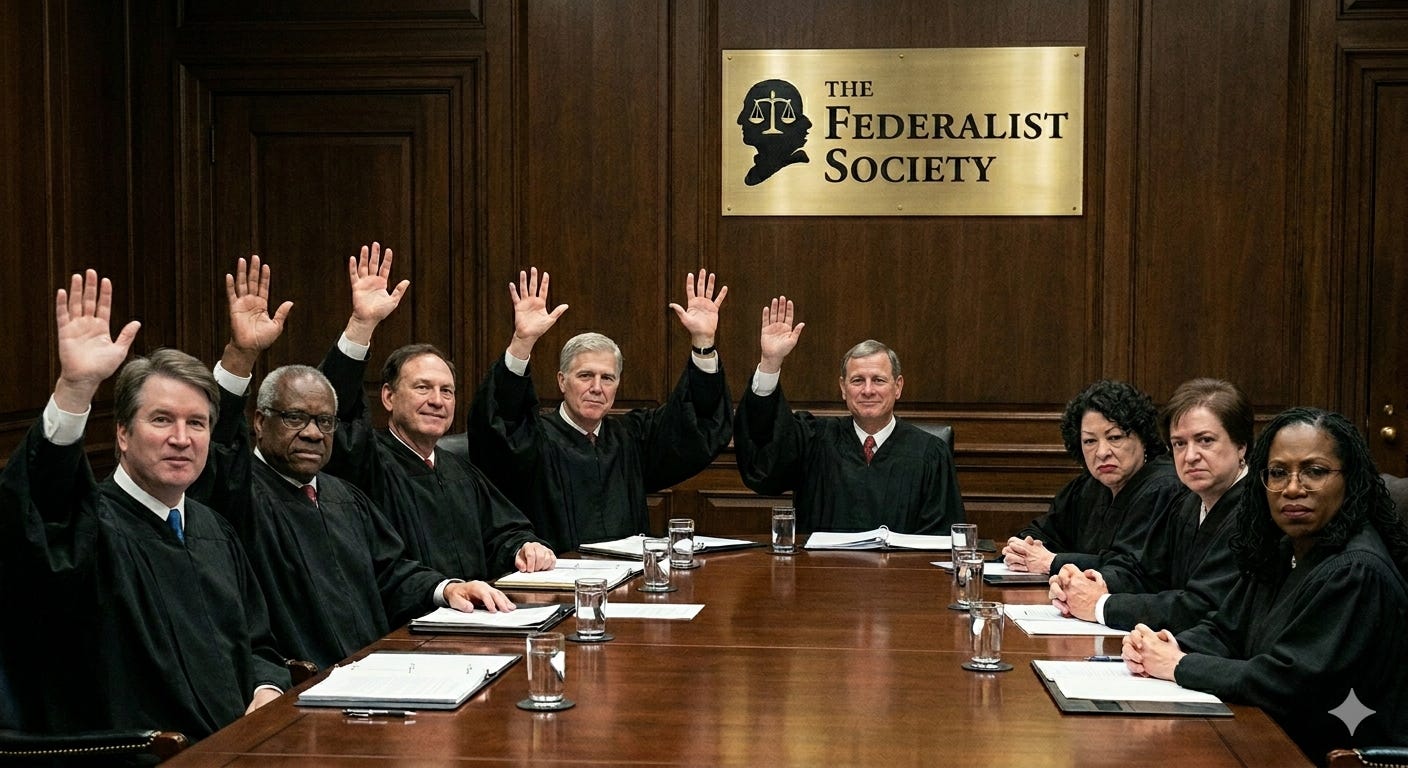
The Federalist Society was founded in 1982 by a group of law students at Yale and the University of Chicago who believed the legal establishment had drifted irreversibly left and that the remedy was a parallel institution — a pipeline for conservative legal talent that would identify, train, credential, and eventually place judges at every level of the federal judiciary.
It worked. Over forty years, the Society built a network that made itself the essential credentialing body for Republican judicial appointments. By the time Donald Trump took office in 2017, the list of acceptable Supreme Court nominees was essentially provided to him pre-screened. He appointed three justices in a single term. The 6-3 supermajority that resulted has since issued rulings on presidential immunity, administrative authority, and executive power that have, in the view of many constitutional scholars, fundamentally rewritten the relationship between the branches.
This was not a conspiracy. It was a strategy, executed legally and patiently over decades. The lesson it teaches is not that the system is broken. It is that the system responds to sustained, organized effort — which is a lesson that cuts in multiple directions.
What the Immunity Ruling Actually Did
The Trump v. United States decision is worth examining precisely because its logic is so breathtaking.
The majority held that in order to protect presidential decision-making from the chilling effect of potential prosecution, presidents must have broad immunity for official acts. The concern, in theory, is reasonable: you don’t want every future president paralyzed by fear of politically motivated prosecution after leaving office.
The problem is what the ruling does to the mechanism of accountability entirely.
If a president’s official acts cannot be prosecuted, and if the definition of “official acts” is broad — and the majority left it intentionally broad — then the president can direct the Justice Department to pursue political enemies, can pressure subordinates to participate in schemes to retain power, can use the instruments of state for personal benefit, and can face no legal consequence for any of it. The courts that were designed to constrain executive power have instead constitutionalized its expansion.
Justice Sotomayor’s dissent enumerated the specific hypothetical abuses the ruling would permit. The majority did not seriously dispute them. It concluded, essentially, that the risk of over-prosecution outweighed the risk of under-accountability.
History will assess that judgment. The assessment is unlikely to be kind.
The Limits of Despair — What Actually Remains
Here is where precision matters, because the temptation is to conclude that if the Supreme Court cannot check the executive, nothing can. That conclusion is wrong, and it is important to understand why.
The Court does not control everything.
The immunity ruling applies to federal prosecution of federal official acts. It does not apply to state criminal proceedings. State attorneys general and district attorneys — in New York, in Georgia, in other states with the political will and legal standing — can pursue cases that federal immunity does not touch. This is not a theoretical observation. It is an active litigation reality.
The Court’s legitimacy is itself a constraint.
Courts have no armies. Their authority rests entirely on the perception that they are legitimate arbiters of law rather than political actors in robes. The current Court’s approval ratings are historically low. The legitimacy crisis is real, and it limits how far even a compliant majority is willing to go — because a Court that is seen as purely partisan loses the one thing that makes its rulings enforceable: voluntary compliance.
Congress retains structural power over the Court.
The Constitution does not specify the number of Supreme Court justices. It does not prohibit term limits. It gives Congress explicit authority over the Court’s appellate jurisdiction. None of these remedies are easy. All of them are legitimate. Court expansion, 18-year term limits with staggered appointments, binding ethics legislation, mandatory recusal standards — these are all proposals with serious bipartisan legal scholarship behind them, not fringe ideas.
The obstacle is not constitutionality. The obstacle is political will — which returns us, as it always does, to the question of elections and the composition of Congress.
Lower federal courts still matter enormously.
The Supreme Court decides roughly 60-80 cases per year. The vast majority of federal legal questions are settled in the circuit courts and district courts, where the Trump administration’s legal positions have frequently lost — including on immigration enforcement, agency authority, and due process. The judiciary below the Supreme Court is not monolithic, and it is not captured.
The Harder Conversation
There is an argument made by some legal scholars — not cranks but serious people — that the current Supreme Court majority has so thoroughly departed from any coherent originalist or textualist methodology, applying those frameworks selectively to reach predetermined conclusions, that it represents a genuine constitutional crisis rather than simply a conservative court doing conservative things.
Chief Justice Roberts has shown occasional independence — voting with the liberal justices in cases where the majority’s reasoning threatened the Court’s institutional standing. That instinct toward institutional preservation is real, and it is not nothing.
But it is also not sufficient. A Court that occasionally defects from maximalist rulings is still a Court that has fundamentally altered the constitutional balance of power, and the mechanisms for correcting that alteration are generational in their timescale unless political conditions change dramatically.
Which means the solution is not primarily legal. It is political. It is electoral. It is the slow, unglamorous work of building the kind of legislative majorities that can reform the Court’s structure, impose ethics requirements, and begin to rebalance the system.
The Court did not capture itself. It was captured by organized, patient political effort over thirty years.
The response, if there is one, will have to operate on a similar timescale — which is an uncomfortable thing to say, and a necessary one.
What the Founders Would Recognize
Madison, in Federalist No. 51, wrote that the structure of government must be designed so that the private interest of every individual is a sentinel over the public rights. The justices appointed through a generation of strategic effort are sentinels — but sentinels for the movement that placed them, not for the public rights Madison had in mind.
The answer is not to abandon the constitutional structure. It is to use the constitutional structure — all of it, including the parts that allow Congress to shape the Court — to restore the balance the Founders intended.
That requires winning elections. Which requires understanding why elections are being lost. Which is a topic for a later installment.
For now: the Court has not ended the game. It has changed the rules. And changed rules, in a democracy, can be changed again.
Next: Part Three — “The Silence of the Enablers” — Why Congress hasn’t acted, why the 25th Amendment remains a dead letter, and what institutional cowardice actually costs.
FTS
Join us on our podcast the Enlightened Cynic, where satire meets substance and storytelling sparks civic engagement. Each episode dives into topics like authoritarianism, political spectacle, environmental justice, humor, history and even fly fishing and more—layered with metaphor, wit, and historical insight. We feature compelling guest interviews that challenge, inspire, and empower, especially for senior audiences and civic storytellers. Listen to the audio on all major podcast platforms, watch full video episodes on YouTube, or explore more at our website.
