The Insurrection That Never Happened
Orban, Beacon to the Right, Concedes Defeat in Hungary’s Election
Prime Minister Viktor Orban of Hungary, a lodestar for MAGA culture warriors and right-wing populists in Europe, conceded defeat on Sunday in a general election, breaking the momentum of a global nationalist revival promoted by President Trump.
In a surprisingly early and gracious concession speech in Budapest, Mr. Orban congratulated the opposition saying, “The responsibility and opportunity to govern were not given to us.” But, he also made a vow: “We are not giving up. Never, never, never.”
New York Times April 12, 2026
Word count: 1,247 words | Reading time: approximately 5 minutes
The Character Contrast: Orbán vs. Trump
Start with what these two men actually have in common, because it makes the contrast so much starker. Steve Bannon, an early MAGA architect, previously described Orbán as “Trump before Trump.” Both men built their power on nationalism, Christian identity politics, contempt for independent courts and media, and an authoritarian grip on their countries’ institutions. They were ideological twins.
And yet when democracy spoke, one of them listened.
Orbán conceded at his Fidesz party headquarters, acknowledged the defeat was painful, and said he had congratulated the opposition Tisza party on its victory. He did it within hours of polls closing, without lawsuits, without claims of fraud, without sending supporters into the streets.
Trump, by contrast, spent months after losing the 2020 election filing dozens of failed court cases, pressuring state officials to “find” votes, orchestrating a pressure campaign on his own Vice President to block certification, and ultimately — on January 6, 2021 — inciting a mob that violently stormed the United States Capitol while Congress was in the process of certifying his defeat. People died. Democracy nearly didn’t survive. And he has never — to this day — genuinely conceded that election.
The difference isn’t just one of character, though it is certainly that. It’s the difference between a politician who lost and an autocrat so consumed by narcissism that the very concept of losing was, to him, an existential impossibility. A healthy ego accepts defeat. A pathological one manufactures an alternate reality rather than face it.
The Deeper Humiliation for Trump
What makes Hungary’s election especially stinging is that Trump went to extraordinary lengths to support Orbán in the final stretch of campaigning — deploying Vice President JD Vance to Budapest and publicly pledging to “use the full Economic Might of the United States to strengthen Hungary’s Economy” if Orbán won. It was an extraordinary and unprecedented intervention by an American president into a foreign election on behalf of a fellow authoritarian. Donald Trump Jr. posted that Orbán had “a direct line to the White House,” as if that were a selling point to Hungarian voters.
It wasn’t.
Trump not only deployed his vice president to Hungary to campaign for Orbán — he also publicly pledged U.S. economic support just two days before Election Day. The message was not subtle. It also didn’t work.
What Hungary’s Voters Actually Did
They showed what happens when a population reaches its breaking point. Many Hungarians had grown increasingly weary of Orbán after three years of economic stagnation and soaring living costs, as well as reports of oligarchs close to the government amassing more wealth. Sound familiar?
Voters turned out at their highest levels since the end of Communist rule, reflecting deep fatigue with Orbán and a newly unified opposition capable of mounting a serious challenge. Magyar built a cross-ideological coalition — disaffected conservatives alongside traditional opposition voters — united by one thing: enough.
As political scientist Jacob Levy explained, it’s not just that Orbán losing inspires hope in other competitive-autocratic countries. It proves the model is beatable. Even when the autocrat controls the courts, the media, the electoral rules, and has the personal backing of the American president and vice president — an angry, motivated electorate can still say no.
What This Portends for the 2026 Midterms
The parallels to Trump’s America are striking and the numbers are alarming for Republicans. Trump is underwater on 10 of the 12 issues tracked in recent polling. His deepest disapproval comes on the national debt, LGBTQ+ rights, and abortion. The economy — voters’ top concern — sits at 43% approve, 51% disapprove.
Trump’s approval rating is above water in just 17 states, down from 22 at the end of 2025 — with five states flipping to net-negative in a single quarter, including Alaska, Iowa, Kansas, Nebraska and Ohio, all states Trump carried in 2024.
The Real Clear Polling aggregate puts Democrats at 47.5% and Republicans at 41.8% on the generic congressional ballot. Democrats continue to post spectacular performances in special elections even as the generic ballot remains stable.
The structural warning for Republicans is severe. Independents and Latinos — two key crossover groups Trump did well with in 2024 — have slid away from him. Democrats did very well in elections throughout 2025. Winning off-year special elections is a historically reliable barometer of which party will do well in the following year’s midterms, and the party in power has always borne the brunt of political punishment in tough economic times.
The Bottom Line
Hungary just demonstrated that when voters are sufficiently motivated — by corruption, economic pain, and the feeling that their country has been stolen from them — even a rigged game can be overcome. The MAGA blueprint, which Orbán helped write, just got shredded in the country where it was perfected.
House Democratic leader Hakeem Jeffries said it plainly: “Far-right authoritarian Viktor Orban has lost the election. Trump sycophants and MAGA extremists in Congress are up next in November. Winter is coming.”
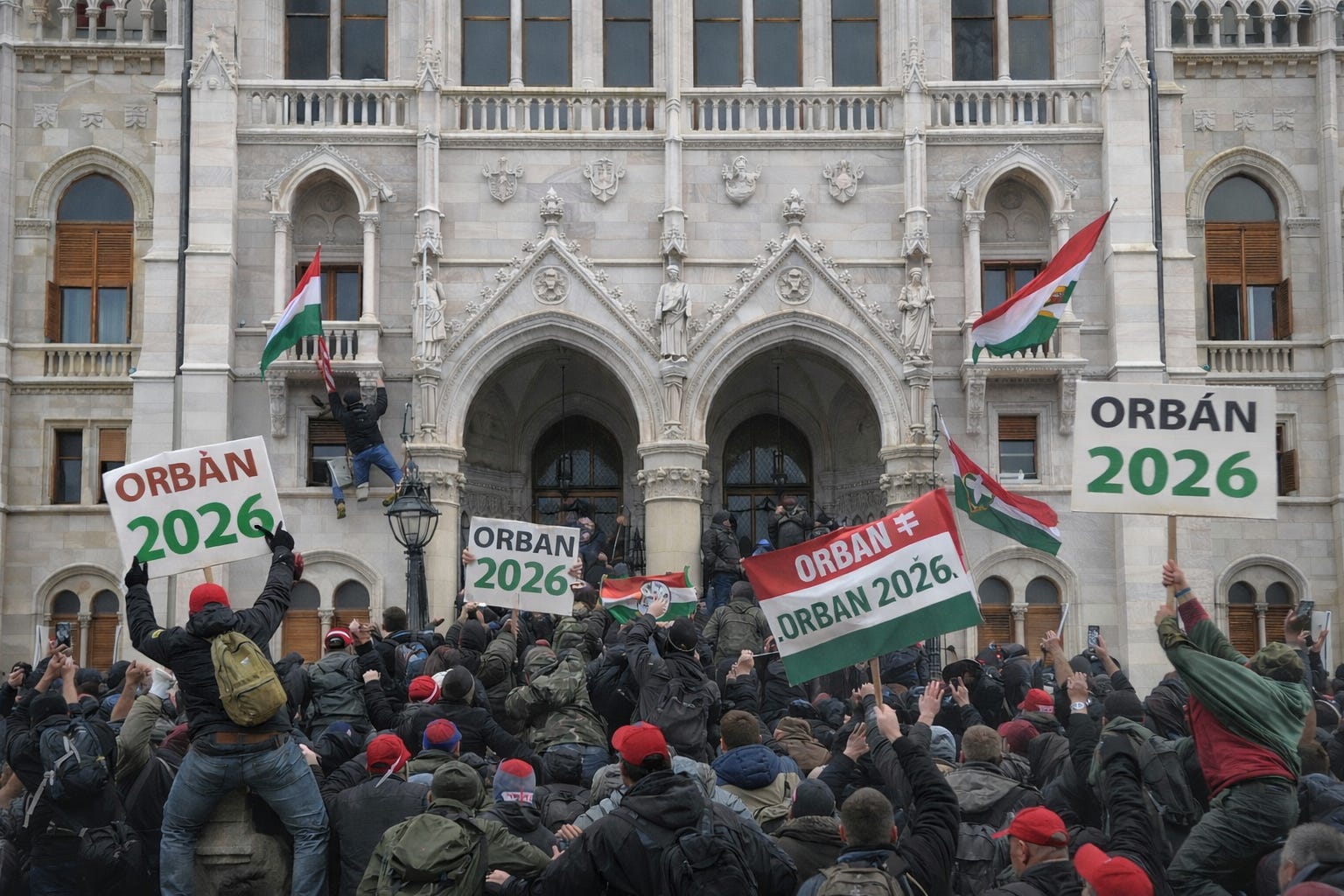
The AI-generated image above of an insurrection that never happened in Budapest is, in the end, the most powerful political argument of all: democracy doesn’t have to look like January 6th. It can look like 80% turnout, a peaceful concession call, and a country choosing its future.
Hungary just chose. America gets its turn in November.
FTS
Join us on our podcast Specifically for Seniors, where satire meets substance and storytelling sparks civic engagement. Each episode dives into topics like authoritarianism, political spectacle, environmental justice, humor, history and even fly fishing and more—layered with metaphor, wit, and historical insight. We feature compelling guest interviews that challenge, inspire, and empower, especially for senior audiences and civic storytellers. Listen to the audio on all major podcast platforms, watch full video episodes on YouTube, or explore more at our website.
Let’s keep the conversation sharp, smart, and unapologetically bold