The Mirrored Mirage: What Rwanda Can Teach Us About the American Twilight
Before we begin — a word about this publication. The Enlightened Cynic is free, and it will stay that way. These conversations are too important to put behind a paywall. But free doesn’t mean costless to produce, and independent voices don’t get heard simply by existing — they get heard when enough people are paying attention. But numbers matter. Subscribers are how Substack’s algorithm notices a publication, how other readers find us, and how an independent voice earns the standing to be heard beyond its current circle. One click. No charge. Considerable difference.
Word count: ~1,650 · Reading time: ~7 minutes
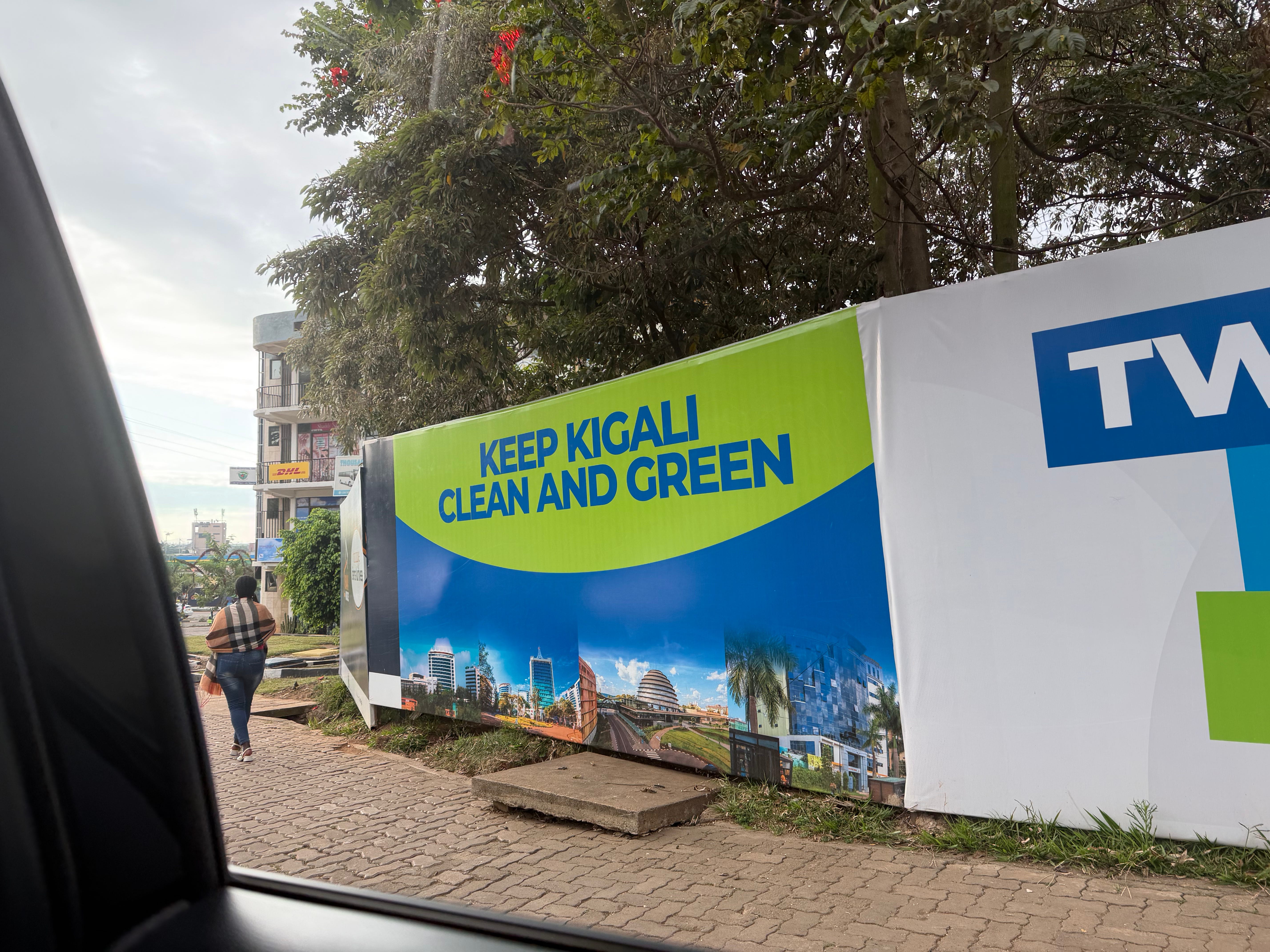
My son and daughter-in-law have just returned from an African safari, part of which took them through Rwanda. They came back, as thoughtful travelers do, with more questions than answers — particularly about the genocide of 1994, in which somewhere between 500,000 and 800,000 Tutsi men, women, and children were systematically murdered in 100 days while the world looked away and found reasons not to intervene.
Their accounts sent me to my desk. I began looking into what Rwanda has become in the three decades since that catastrophe — its governance, its social architecture, its public health achievements — and found myself drawn, almost involuntarily, into a comparison with the country I have spent 89 years observing at close range. What I found was not what I expected.
To understand the structural trajectory of the United States under the current political arrangement — Donald Trump’s executive branch, a compliant Republican Congress, and a Supreme Court majority committed to rolling back the administrative state — I want to suggest that you stop looking at London, Paris, and Berlin for reference points. Cast your gaze instead toward East Africa. Specifically, toward the Republic of Rwanda.
The comparison will strike some readers as a provocation. The United States is a post-industrial economic superpower with a GDP per capita exceeding $85,000. Rwanda is a developing, landlocked agrarian nation where that figure hovers around $1,200. And yet, if you strip away the dollar signs and examine the machinery of power and institutional health, you find a disquieting paradox. The United States is entering a phase of political consolidation that structurally resembles an authoritarian regime — but it is doing so without acquiring any of the social stability or functional civic outcomes that such systems use to justify their existence.
I. The Mechanics of Narrative Control
In Rwanda, narrative management under President Paul Kagame and the ruling Rwandan Patriotic Front is surgical and absolute. There is no platform for dissent because the state does not allow one. Opposition figures are systematically disqualified or detained; independent journalism is treated as a threat to national unity; the permissible boundaries of public reality are set and enforced from above. It is a closed system.
The American executive branch cannot legally shutter a newspaper or jail a television anchor — the First Amendment remains a stubborn piece of parchment. But the current administration has developed a different set of tools. When the Pentagon implemented guidelines seeking to prohibit reporters from publishing even unclassified information without explicit government sign-off, it was an attempt to import a top-down information blockade. The press corps walked out collectively, and a federal court struck the policy down as unconstitutional. The guardrails held — this time.
But the intent behind such policies is worth naming plainly. By weaponizing regulatory threats against broadcast licensees, pressuring social media platforms to suppress inconvenient content, and waging a sustained campaign to discredit independent journalism as “the enemy of the people,” the administration is pursuing a chilling effect through friction rather than decree. Rwanda controls the narrative through a monopoly on speech. The current American apparatus pursues something more insidious: the erosion of the public’s ability to distinguish fact from assertion until it simply stops trying.
II. Healthcare as a Right vs. Healthcare as a Market
It is in the distribution of basic healthcare that the American paradox becomes most difficult to defend.
Rwanda, operating with a fraction of America’s resources, established the Mutuelles de Santé — a universal insurance framework covering more than 90% of its population. Premiums are tiered by household income; the poorest citizens pay nothing. Backed by 45,000 community health workers deployed to rural villages, Rwanda has achieved one of the sharpest declines in maternal and infant mortality in modern history — dropping from 1,116 maternal deaths per 100,000 live births in the year 2000 to roughly 149 today. That is an 87% reduction, accomplished in a country still rebuilding from catastrophic trauma.
The United States sits at a maternal mortality rate of 17.9 — a figure that looks tolerable until you disaggregate it. For Black women in America, the rate is 44.8 deaths per 100,000 live births, nearly three times the rate for white women. In the wealthiest nation in human history, spending nearly 18% of its GDP on healthcare. The current administration’s rollback of federal healthcare standards, combined with maternity care deserts spreading across states that have restricted reproductive access, ensures that the American system remains organized around revenue rather than survival.
We can build robotic surgical systems. We cannot keep a rural mother from dying in a county without a single obstetrician. That is not a resource problem. It is a choice.
III. The Monopoly on Violence — and Its American Inversion
An authoritarian state is defined, at minimum, by its monopoly on the instruments of force. In Rwanda, that monopoly is total and deliberate. Following the 1994 genocide — in which neighbors killed neighbors with machetes — the state enforced an uncompromising premium on internal security. Private firearm ownership is essentially nonexistent. Unauthorized possession carries severe criminal penalties. The streets of Kigali are among the safest on the continent. Whatever one thinks of Rwanda’s political repression, the government fulfills its most basic contract with its citizens: they will not be randomly shot.
The current American arrangement offers a different bargain — or rather, no bargain at all. We absorb more than 40,000 gun-related shootings and more than 400 mass shooting incidents annually, a baseline of violence without parallel among industrialized nations. The Supreme Court’s steady expansion of Second Amendment interpretations has systematically reduced the capacity of states and municipalities to pass public safety ordinances. The political consensus treats this daily carnage not as a policy failure but as the price of liberty.
The result is a government that is increasingly assertive in claiming executive authority while completely abdicating its responsibility to protect its citizens from each other. We are becoming, in effect, an authoritarian state that cannot keep children safe in their classrooms.
IV. Eldercare, Climate, and the Horizon
The moral character of a society can be read in how it treats its elderly and how it manages its ecological inheritance. On both counts, the divergence between the two countries is instructive.
American eldercare has become a financial gauntlet. Private equity firms acquire assisted living facilities and systematically reduce staffing to optimize returns. For an ordinary family, a prolonged illness or memory care need is an existential economic event, requiring the liquidation of a lifetime’s assets to qualify for Medicaid. Loneliness among American seniors is not a personal failing; it is the predictable byproduct of a system that treats the aged as a cost to be minimized and segregates them accordingly.
In Rwanda, commercial nursing homes are a cultural anomaly. Multiple generations share a household; care of the elderly is an unwritten social obligation. For those without families — often because the genocide took everyone — community networks absorb them. The elder remains an integrated member of village life rather than a line-item expense.
On climate: Rwanda banned non-biodegradable plastic bags in 2008. Every citizen, from laborer to cabinet minister, participates in Umuganda — the mandatory monthly community service dedicated to reforestation, erosion control, and public maintenance. The current Washington consensus, by contrast, treats climate science as a partisan inconvenience, has expanded fossil fuel extraction on public lands, and has withdrawn from international ecological obligations. One government uses its authority to preserve its landscape for the next generation. The other uses its authority to auction it off.
V. The Real Nature of the Decline
We are not becoming Rwanda. That would require a level of organizational discipline, administrative competence, and collective social investment that the current American political architecture is neither pursuing nor capable of delivering.
The genuine danger is more specific. We are constructing a system that combines the coercive characteristics of an autocracy — systematic pressure on the free press, erosion of judicial independence, executive capture of the civil service, the deployment of state power against political opponents — with the chronic dysfunctions of a fragmented, commercialized democracy. It is the worst of both worlds.
The result is a society where you can still criticize the government loudly and at length, but your criticism will change very little, because the mechanisms for translating public will into policy have been methodically weakened. Where the state has expanded its capacity to surveil and intimidate, but has not expanded — has actively contracted — its capacity to ensure that your child is safe at school, that your mother does not die bankrupt in an understaffed facility, or that the county where you live has a doctor who delivers babies.
Rwanda traded political freedom for social order and collective provision. It is a trade I would not make. But the current American trajectory is not offering that trade. It is claiming the authority without assuming the responsibility. It is the consolidation of power with none of the competence — and that, finally, is what makes this moment not merely frustrating but genuinely dangerous.
A Note After Publication
A word about how this piece came together. I discussed an early draft with my son Andy during his flight back to the United States — the advantages of modern technology — and he had some observations too good not to share.
“You nailed so much of what we’ve been talking about,” he said, “but you missed something important: education, and the way Rwanda owns its past. Everyone there acknowledges the genocide. It is not hidden. It is not whitewashed. There are memorials. There is a national reckoning. The culture insists on it.”
He is right, and I’m grateful for the correction. The contrast is pointed. The United States is currently engaged in the opposite exercise — banning books, scrubbing curricula, and legislating away any classroom discussion of our own racial history that might cause discomfort. Rwanda, a country that has infinitely more reason to look away from its past, has chosen not to. We, apparently, have made the other choice.
Andy also offered what I think is the single most clarifying frame for everything I’ve written above: “It’s a lot like Singapore,” he said. “The streets even look the same. Benevolent dictatorship. The government is in full control, but it really takes care of everyone.”
Benevolent dictatorship. That phrase does a great deal of work. It explains both why Rwanda’s achievements are genuinely admirable and why the model isn’t transferable to a constitutional republic — and it sharpens the central irony of this piece considerably. We seem to be acquiring the dictatorship part without troubling ourselves overmuch about the benevolent part.
But intellectual honesty requires a footnote to Andy’s observation. The benevolence is real — for those who do not challenge the state. For those who do, the picture is considerably darker. Freedom House documents a pattern of pervasive surveillance, arbitrary detention, torture, and the suspected assassination of exiled dissidents. In the 2024 presidential election, Kagame won 99.15% of the vote — a number that is not a measure of popularity so much as a measure of what happens to viable opposition. Journalists operate under conditions of ubiquitous censorship and self-censorship. The streets are clean and the hospitals function, but the man who built them has also manipulated his own constitution to keep himself in power until at least 2034.
So “benevolent dictatorship” is the honest impression of a thoughtful traveler moving through a country that works — and it is accurate as far as it goes. It simply doesn’t go all the way. The benevolence is conditional. The dictatorship is not.
“They really are amazing people,” Andy added, about the Rwandans he met along the way.
On that, I have no argument whatsoever. And I’m glad they went.
The Enlightened Cynic is published by Larry Barsh, DMD. Subscribe at larrybarshdmd.substack.com · larry@enlightenedcynic.com
FTS
Join us on our podcast the Enlightened Cynic, where satire meets substance and storytelling sparks civic engagement. Each episode dives into topics like authoritarianism, political spectacle, environmental justice, humor, history and even fly fishing and more—layered with metaphor, wit, and historical insight. We feature compelling guest interviews that challenge, inspire, and empower, especially for senior audiences and civic storytellers. Listen to the audio on all major podcast platforms, watch full video episodes on YouTube, or explore more at our website.
