The Most Conflicted Man in the Room
Word count: ~920 words
Reading time: 4–5 minutes
There is a basic expectation in American foreign policy: when the United States sits across the table from adversaries or allies, the person representing the country is accountable to the public.
That expectation is no longer as clear as it once was.
In the years since leaving government, Jared Kushner—former senior advisor and son-in-law to Donald Trump—has occupied an unusual space. He is not a diplomat. He holds no official title. He files no public financial disclosures. And yet, by multiple credible accounts, he remains engaged in conversations that intersect with U.S. policy in the Middle East.
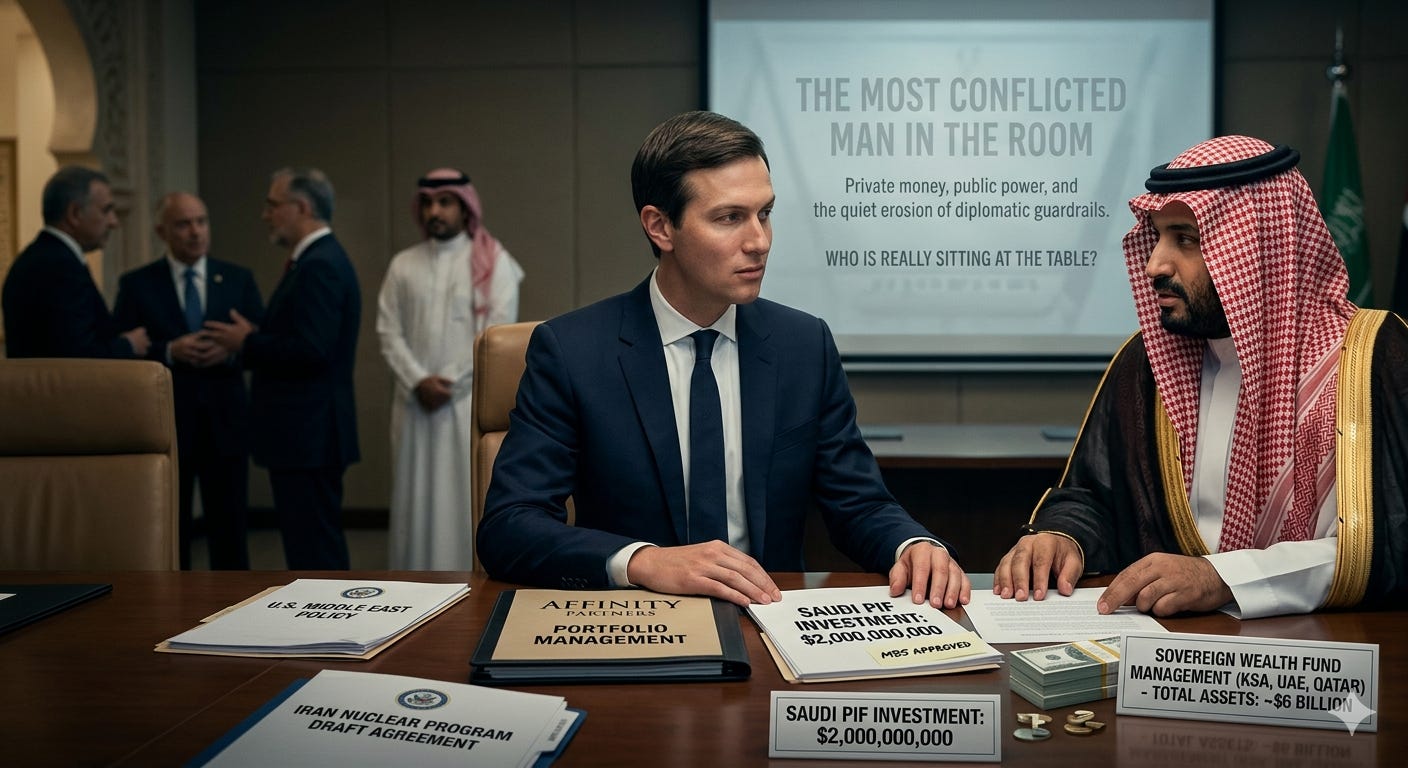
At the same time, he runs a private equity firm, Affinity Partners, now managing roughly $6 billion—much of it from sovereign wealth funds in Saudi Arabia, the United Arab Emirates, and Qatar.
That overlap is not illegal. But it is something else: structurally uncomfortable.
And in diplomacy, discomfort matters.
Where the Lines Blur
The issue is not that Kushner has influence. Former officials often do. The issue is the combination of influence and financial dependence on the same region where that influence is exercised.
Shortly after leaving the White House, Kushner secured a $2 billion investment from Saudi Arabia’s Public Investment Fund. That decision reportedly came despite internal objections from the fund’s own advisers, who cited both his lack of a private equity track record and the appearance of political favoritism. The investment was approved anyway by Crown Prince Mohammed bin Salman.
Since then, additional Gulf capital has followed.
This creates a reality that would have been almost unthinkable in earlier eras of American diplomacy: A former senior U.S. official, still active in geopolitical discussions, whose business success is tied in part to governments directly affected by those discussions.
No statute clearly forbids this. But ethics concerns don’t begin and end with legality. They begin with alignment—or the lack of it.
Influence Without Accountability
When Kushner operated inside the White House, he did so—controversially, at times—within a defined structure. There were disclosure rules. There was congressional oversight. There were at least nominal institutional constraints.
Outside government, those constraints disappear. That doesn’t mean influence disappears with them. It means influence becomes harder to see.
Reporting over the past several years indicates that Kushner has continued to engage in conversations involving Middle East policy, drawing on relationships built during his time in office. He is not formally negotiating on behalf of the United States. But he is not simply a bystander either.
This is the gray zone: informal diplomacy without formal accountability.
And it raises a question that no administration has answered clearly: How much influence can a private citizen wield in foreign policy before transparency becomes necessary?
The Stakes Are Not Abstract
This is not a theoretical ethics seminar. It plays out against one of the most volatile and consequential issues in global politics: Iran’s nuclear program.
In 2015, the United States and its partners negotiated the Joint Comprehensive Plan of Action—a complex agreement that placed verifiable limits on Iran’s nuclear activities in exchange for sanctions relief.
The deal was imperfect, but it imposed structure: inspections, timelines, constraints. In 2018, the United States withdrew.
What followed was a familiar pattern in international affairs: pressure without agreement, escalation without resolution, and a steady erosion of constraints that had once been in place.
Today, the same fundamental question remains unresolved: What limits on Iran’s nuclear program are credible, enforceable, and politically sustainable?
That question requires trust—not just between nations, but in the people doing the negotiating.
Perception Is Power
In diplomacy, perception is not a sideshow. It is often the main event.
Even if no decisions are influenced by private financial interests, the perception that they could be is enough to complicate negotiations. Every party at the table—whether Iran, Gulf states, or U.S. allies—understands the financial landscape surrounding the individuals involved. They do not need proof of conflict. They need only uncertainty.
And uncertainty erodes credibility.
If a figure engaged in diplomatic conversations is also managing billions of dollars tied to regional governments, the question naturally arises: Whose interests are primary—and how would anyone know if that changed? That question does not require an accusation to be damaging. It only requires plausibility.
A System, Not an Exception
It would be easy to frame this as a story about one individual. It is not. It is a story about a broader shift in how power operates.
The traditional model of American foreign policy rested on institutions: the State Department, the intelligence community, a professional diplomatic corps. Authority flowed through roles that came with rules.
That model has not disappeared. But it now coexists with something more fluid—more personalized, more dependent on relationships, more tolerant of blurred lines between public responsibility and private interest. Supporters argue this allows flexibility. That trusted individuals can move faster, think creatively, and cut through bureaucracy.
Critics see something else: the gradual weakening of safeguards designed to ensure that U.S. policy serves the public interest first and last.
The Quiet Risk
There is no clear evidence that Jared Kushner has altered any specific U.S. policy decision to benefit his investors. But that is not the only standard that matters.
In foreign policy, the durability of agreements depends on trust—in motives, in commitments, in the system behind the negotiator. When that system becomes opaque, even well-intentioned actions can lose credibility.
The risk is not always corruption in the explicit sense. The risk is ambiguity. And ambiguity, in high-stakes diplomacy, is rarely neutral.
The Question That Doesn’t Go Away
Strip away the personalities, the politics, the noise, and the situation reduces to something simple:
A private investor with deep financial ties to Middle Eastern governments remains connected—formally or informally—to discussions about U.S. policy in that same region.
That may be defensible. It may even be legal. But it leaves behind a question that no administration, Republican or Democrat, should be comfortable ignoring:
When American foreign policy is being shaped—even at the margins—by individuals with private financial stakes in the outcome, how does the public know whose interests come first?
Until there is a clear answer, the most important negotiations in the world will carry an unspoken complication—
Not just what is being decided, but who is really sitting at the table.
FTS
Join us on our podcast Specifically for Seniors, where satire meets substance and storytelling sparks civic engagement. Each episode dives into topics like authoritarianism, political spectacle, environmental justice, humor, history and even fly fishing and more—layered with metaphor, wit, and historical insight. We feature compelling guest interviews that challenge, inspire, and empower, especially for senior audiences and civic storytellers. Listen to the audio on all major podcast platforms, watch full video episodes on YouTube, or explore more at our website.
Let’s keep the conversation sharp, smart, and unapologetically bold