The November Imperative
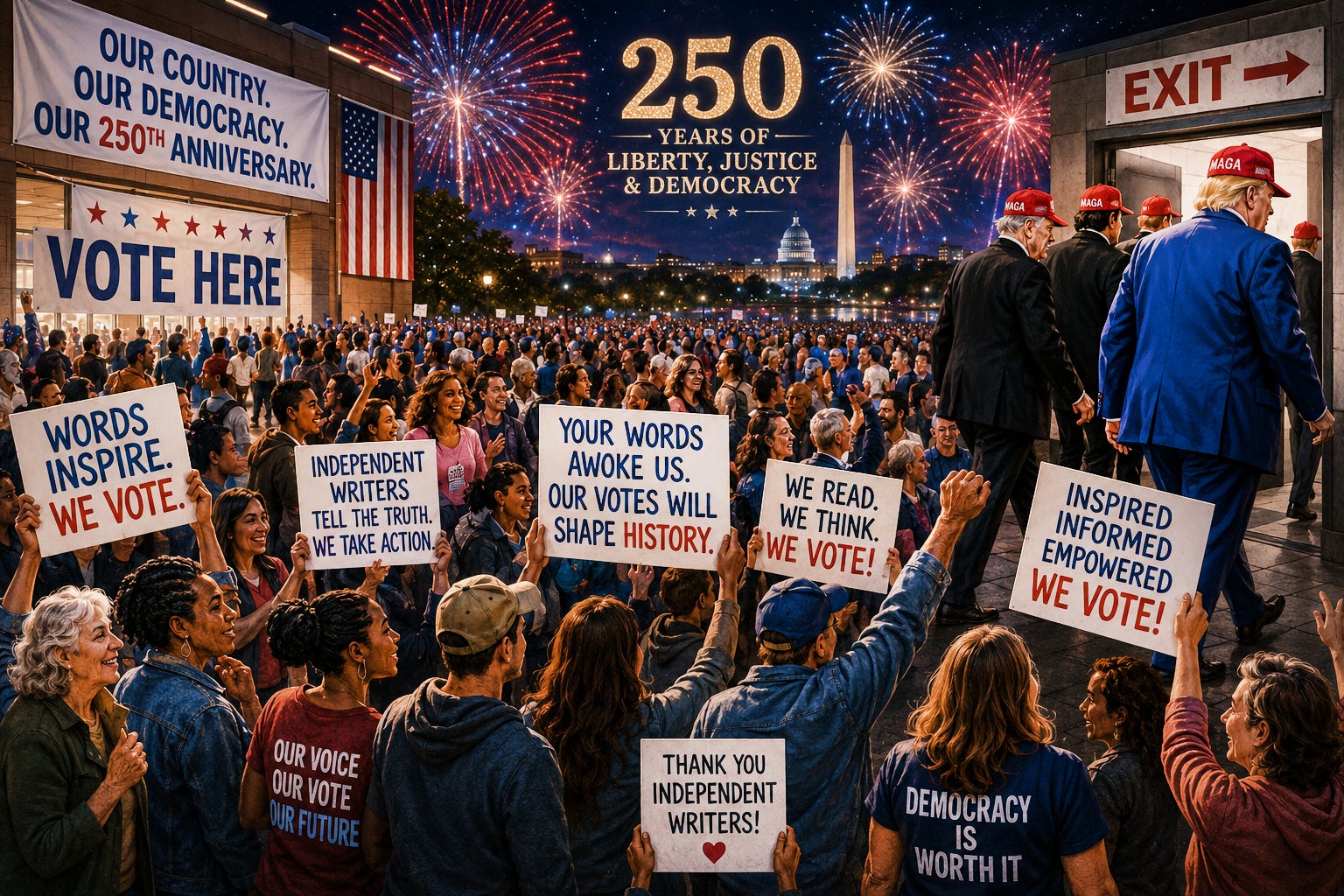
Part Five of Five: The Republic We Were Promised
Word count: 1,700 | Estimated reading time: 6.5 minutes
Let us end where all of it ends, and begins: with the voter.
Not the voter as abstraction — not “the American people” as rhetorical flourish or civic wallpaper — but the specific human being who has to decide, whether to show up to a primary election that most of her neighbors don’t know is happening, in a race that won’t make the national news, for a candidate who may not be exciting, to cast a vote that will feel, in the moment, like dropping a grain of sand on a beach.
Everything in this series — the Supreme Court, the Congress, the cabinet, the independent press, the coalition of writers — points back to this person. Because every structural remedy discussed in the preceding installments requires, as a precondition, a different Congress. And a different Congress requires different members. And different members require primary voters willing to replace the ones who have chosen enablement over accountability.
The primaries are where that starts. And they are, by a considerable margin, the most underattended civic event in American democracy.
What Primaries Actually Are — and Why They’re Decisive
In a general election, a candidate has to appeal to a broad electorate. In a primary, a candidate has to appeal to the subset of registered party members who show up to vote — which, in most congressional districts, is a small fraction of the eligible population.
Turnout in congressional primaries typically runs between 10 and 20 percent of registered voters. In many districts, the number is lower. What this means in practice is that the composition of Congress — and through it, the composition of the Supreme Court, the fate of the 25th Amendment, the oversight capacity of the legislative branch — is determined by a relatively small number of highly motivated voters.
This is not a bug. It is a feature that can be used.
The same mechanism that has allowed an organized and motivated minority to push the Republican Party toward increasingly extreme positions over the past fifteen years — the Tea Party primary challenge, the Freedom Caucus insurgencies, the MAGA takeover of state parties — can be used by an organized and motivated opposition to produce different outcomes in competitive districts and states.
The primaries matter because they determine who appears on the general election ballot. A primary electorate that rewards courage and punishes enablement sends different candidates to the general. A primary electorate that stays home sends the same candidates — or worse ones.
The math is not comfortable. But it is not impossible.
What the November 2026 Midterm Elections Are Actually About
The current Republican majority in both chambers of Congress is not a mandate. It is a margin — and margins can be moved.
In the Senate, Republicans hold a 53-47 advantage. Democrats need a net gain of four seats to take the majority — demanding, but not unprecedented in a midterm environment that historically punishes the president’s party. The map offers genuine targets. North Carolina is a true tossup: Thom Tillis retired, former Governor Roy Cooper secured the Democratic nomination, and both parties are spending heavily. In Maine, Susan Collins faces the most competitive race of her career. In Ohio, Sherrod Brown — who held that seat for eighteen years — is running again against an appointed incumbent who has never faced a statewide electorate. Democrats will also need to hold Georgia and Michigan, where open seats and vulnerable incumbents make defense as important as offense.
The House is closer still. Republicans hold a 220-213 majority — one of the thinnest in modern history. Democrats need just four seats to flip the chamber. Seventeen districts are currently rated true tossups, concentrated in the suburban Arizona, California, Pennsylvania, and Washington districts that have been trending Democratic since 2018. One forecaster currently puts Democratic odds of winning the House at 72 percent. Forecasts are not results. But the structural environment is reinforced by an extraordinary retirement wave: fifty-six House members are not seeking reelection, thirty-six of them Republicans — the second-highest retirement total in American history. Republicans who have read the environment are leaving. That should tell Democratic voters something.
What majority control actually means, concretely: a Democratic Senate returns subpoena power to oversight committees, forces bipartisan negotiation on judicial confirmations, and gives Court reform legislation a path to the floor. A Democratic House means the the Judiciary Committee can conduct genuine oversight hearings, and the Appropriations Committee can use the power of the purse the way the Founders intended it to be used.
In the simplest possible terms: the machine has three parts. Right now two of them point in the same direction. November is how you fix that.
The single most important electoral fact of this moment is not persuasion — the suburban, college-educated voters in tossup districts are already persuadable. It is turnout. These voters show up in presidential years and stay home in midterms. That gap is the difference between a Democratic majority and another two years of institutional paralysis. It is also, unlike the Supreme Court’s composition or the cabinet’s calculations, something individual civic action can directly affect.
Show up. Bring someone. Know which race in your district actually matters.
You are one of a very small number of people deciding something very large.
The Obstacles Are Real — So Is the Path
Voter mobilization is harder than it sounds, and anyone who tells you otherwise is either naive or selling something. The obstacles deserve honest enumeration:
Apathy is rational in the short term. The individual voter’s impact on any single election is statistically negligible. The decision to show up anyway requires believing that aggregate action matters — a belief that requires sustained maintenance in an environment designed to produce cynicism.
The information environment works against engagement. The same algorithmic dynamics that sustain cult loyalty also produce exhaustion and despair in the opposition. Doom-scrolling and political engagement are not the same thing. Many people who are intensely aware of the situation are not taking the specific actions — voter registration, primary participation, local organizing — that would change it.
Geographic concentration limits impact. Democratic voters are heavily concentrated in urban areas that are already won. The marginal impact of additional Democratic votes in Manhattan or San Francisco is zero. The marginal impact in suburban districts in Georgia, Arizona, Pennsylvania, Michigan, and Wisconsin is potentially decisive.
Candidate quality is uneven. Not every primary produces a strong candidate. Sometimes the choice is between a weak candidate and a worse one, which is a legitimate reason for frustration and an insufficient reason for abstention.
These obstacles are real. They do not add up to hopelessness. They add up to a specific kind of work that is harder than it should be and more important than almost anything else available.
What Actually Moves Voters — and What Doesn’t
Decades of political science research on voter mobilization produces a consistent finding: the most effective mobilization is relational, not transactional. People vote when people they know ask them to, in person, with genuine human connection. Mailers don’t work. Most digital ads don’t work. Canvassing by strangers has modest effects.
What works is social embeddedness — when voting is a normal thing that people in your community do together, when not voting requires an explanation, when civic participation is a shared expectation rather than an individual heroic act.
This is where the coalition of writers and thinkers described in the previous installment connects to the electoral project. The writers who reach audiences of thousands or tens of thousands are not just publishing political analysis. They are, or can be, nodes of the social networks that make civic participation feel normal and expected.
The most important thing an independent writer can do in the run-up to November 2026 is not publish another piece about what is wrong. It is to tell their readers, specifically and repeatedly, what to do: register, check your registration, find your primary date, find your polling place, go. And then ask them to tell three people they know to do the same.
This is not glamorous. It is not the stuff of memorable political writing. It is, however, what the research says works.
The Long Game and the Short One
This series has argued, across five installments, that the crisis of American democracy is structural, that its causes are deep, and that the remedies are slow. All of that is true. It is also true that slow remedies have to start somewhere, and that the somewhere available right now is November 2026.
The Supreme Court will not self-correct before then. The cabinet will not invoke the 25th Amendment before then. The coalition of independent writers will not, by itself, change the information environment sufficiently to shift the political landscape before then.
What can happen before then is an election. And elections, in a democracy, are not the end of the argument. They are the mechanism by which the argument gets to continue.
Two hundred and fifty years ago, a group of people made a bet that human beings, organized into a constitutional republic with separated powers and protected rights and regular elections, could govern themselves without a king. It was, by the standards of history, an audacious and improbable bet.
It has not always paid off. The republic has been closer to failing than the textbooks usually acknowledge. It has survived — imperfectly, unevenly, at tremendous cost borne disproportionately by people who had the least — because enough people, in enough moments, decided that the bet was still worth making.
The vote is how you make the bet.
Show up for the primary. Tell three people. Mean it.
The fireworks this summer will be spectacular. What happens in November will matter more.
To get reliable, up-to-date voting information, visit TurboVote by Democracy Works.
This concludes “The Republic We Were Promised,” a five-part series on democracy, deference, and the fight to get it back.
Part One: What 250 Years Actually Looks Like
Part Two: The Court That Couldn’t
Three: The Silence of the Enablers
Part Four: The Coalition of the Willing
Part Five: The November Imperative
FTS
Join us on our podcast the Enlightened Cynic, where satire meets substance and storytelling sparks civic engagement. Each episode dives into topics like authoritarianism, political spectacle, environmental justice, humor, history and even fly fishing and more—layered with metaphor, wit, and historical insight. We feature compelling guest interviews that challenge, inspire, and empower, especially for senior audiences and civic storytellers. Listen to the audio on all major podcast platforms, watch full video episodes on YouTube, or explore more at our website.
