The Number Is Wrong. The Outrage Is Right.
Before we begin — a word about this publication. The Enlightened Cynic is free, and it will stay that way. These conversations are too important to put behind a paywall. But free doesn’t mean costless to produce, and independent voices don’t get heard simply by existing — they get heard when enough people are paying attention. But numbers matter. Subscribers are how Substack’s algorithm notices a publication, how other readers find us, and how an independent voice earns the standing to be heard beyond its current circle. One click. No charge. Considerable difference.
Word count: approximately 900 words | Estimated reading time: 3.5 minutes
You’ve probably seen the claim circulating on social media: one-third of all federal debt since the founding of the United States is attributable to Donald Trump, the Republican Party, and his billionaire friends.
It’s a striking number. It’s also slightly wrong.
The correct figure is closer to one-quarter.
I want to sit with that for a moment — not to let anyone off the hook, but because the accurate number is, if anything, more damning than the inflated one. It doesn’t need exaggeration. It doesn’t need spin. It simply needs to be understood.
250 Years
The United States of America is approaching its 250th birthday.
In two and a half centuries, this country has survived a Revolutionary War, a Civil War, two World Wars, a Great Depression, a Cold War, the New Deal, the Great Society, the moon landing, the 2008 financial collapse, and a global pandemic. It has financed all of it — the blood, the infrastructure, the social safety net, the aircraft carriers, the interstate highways, the vaccines — by borrowing money.
The total bill, accumulated across every administration from George Washington to the present, now stands at approximately $39 trillion.
That is the ledger of 250 years.
The Arithmetic
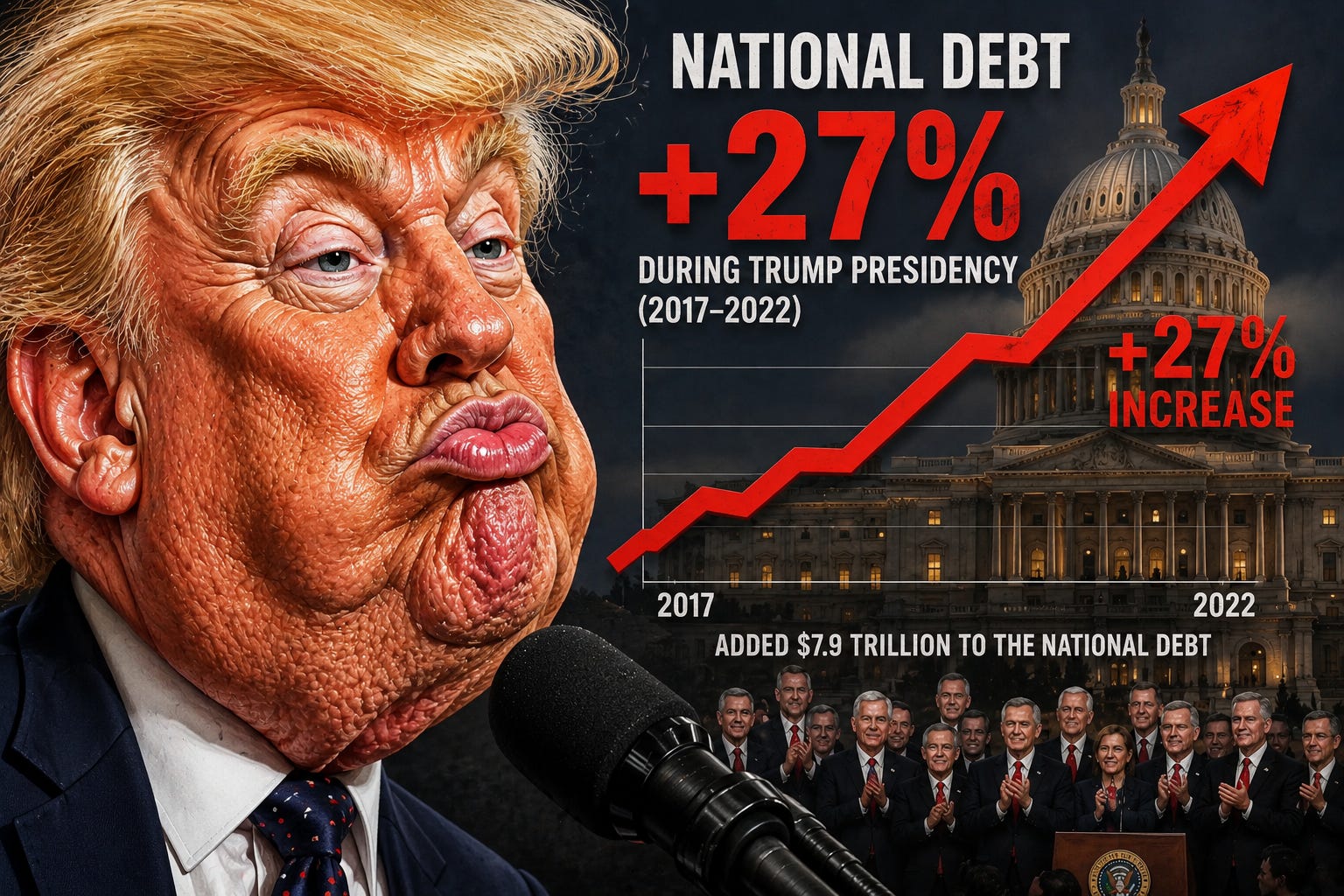
During Donald Trump’s first term (2017–2021), the national debt increased by approximately $8.18 trillion — a 40% jump in four years.
During the first year of his second term, the debt rose by another $2.25 trillion.
Combined: roughly $10.4 trillion. Against a total debt of $39 trillion, that is approximately 27 percent — more than one dollar in four of everything this country has ever borrowed.
Not one-third. One-quarter. I wanted to be precise, because precision is the point.
What One-Quarter Actually Means
Franklin Roosevelt guided the country through the Depression and World War II. Abraham Lincoln financed the Civil War. Lyndon Johnson built Medicare and Medicaid. George W. Bush launched two wars and a financial bailout. Barack Obama inherited the wreckage of the 2008 collapse.
All of them borrowed money. All of them added to the debt. That is what governments do in extremis.
And yet: in 250 years of American history, through every catastrophe and crusade this republic has faced, one man’s two terms in office account for more than a quarter of the entire accumulated debt of the United States.
To be scrupulously fair — because that is what separates analysis from propaganda — a significant portion of Trump’s first-term debt came from COVID relief legislation that passed with broad bipartisan support. Pandemics are expensive. That is not a partisan observation.
But the 2017 Tax Cuts and Jobs Act — the crown jewel of the first term, the one that sent the Republican caucus into paroxysms of self-congratulation — added an estimated $1.8 trillion to the debt on its own, by design, with the explicit purpose of concentrating its benefits at the top of the income distribution. That was not a response to a crisis. That was a choice. A very expensive choice, made by very comfortable people, to be paid for by everyone else.
On the Virtue of Getting It Right
Here is why the distinction between one-third and one-quarter matters:
When the number is inflated, it becomes a target. It invites the obvious rebuttal — “well, actually” — and suddenly the conversation is about the error rather than the reality. The people who want to change the subject are handed a gift.
The accurate figure needs no such gift. It stands entirely on its own. It is, by any historical measure, extraordinary. It is the kind of number that, stated plainly, in good company, with a glass of something cold in hand, produces a long silence.
Twenty-seven percent of all the debt accumulated in 250 years of American history.
In eight years — or, more precisely, in five years so far.
That is the number. No rounding required.
Who Pays the Bill
There is one more thing the numbers don’t say on their own, and it may be the most important thing of all.
This debt does not disappear. It does not expire. It does not get quietly absorbed by the passage of time. It gets handed down.
Your children and grandchildren, my children and grandchildren — and, at the current trajectory, their children after them — people who had no vote in the Tax Cuts and Jobs Act, no seat at the table when the spending bills were signed, no stake in the grievances and ambitions that drove the decisions — will inherit this ledger. They will spend a meaningful portion of their working lives servicing interest on money borrowed before they were old enough to have an opinion about it. And when they are gone, they will pass what remains to the generation after them. The bill does not get smaller. It compounds.
The American Dream, in its most durable form, has always rested on a simple compact: each generation leaves the next one a little more room to breathe. More opportunity. Less burden. A longer runway.
That compact is being broken.
The children and grandchildren of today’s America are not inheriting a nation unburdened by the past. They are inheriting $39 trillion in accumulated obligations — a quarter of which was run up in the last eight years alone — along with the compounding interest on all of it, in an economy where housing costs a fortune, college costs a ransom, and the middle class grows thinner with each passing decade.
This is not an abstraction. It is a transfer — from the future to the present, from the comfortable to the young, from those who have no voice yet to those who have had every advantage and used it, among other things, to cut their own taxes.
The word for that, in plain English, is not fiscal policy.
It is inheritance theft.
The Enlightened Cynic is produced for the discerningly disillusioned. If you found this useful, consider sharing it with someone who prefers their outrage well-sourced.
FTS
Join us on our podcast the Enlightened Cynic, where satire meets substance and storytelling sparks civic engagement. Each episode dives into topics like authoritarianism, political spectacle, environmental justice, humor, history and even fly fishing and more—layered with metaphor, wit, and historical insight. We feature compelling guest interviews that challenge, inspire, and empower, especially for senior audiences and civic storytellers. Listen to the audio on all major podcast platforms, watch full video episodes on YouTube, or explore more at our website.
