The Rallies Were Ahab. The White House Is the Caine.
~1,500 words · 6–7 min read
It started with listening to a podcast. Heather Cox Richardson, the guest — the historian whose Letters from an American has become essential reading for anyone trying to make sense of the current political moment — raised the comparison almost in passing: that Donald Trump and Captain Ahab might be usefully read against each other. It was the kind of observation that lands quietly and then refuses to leave.
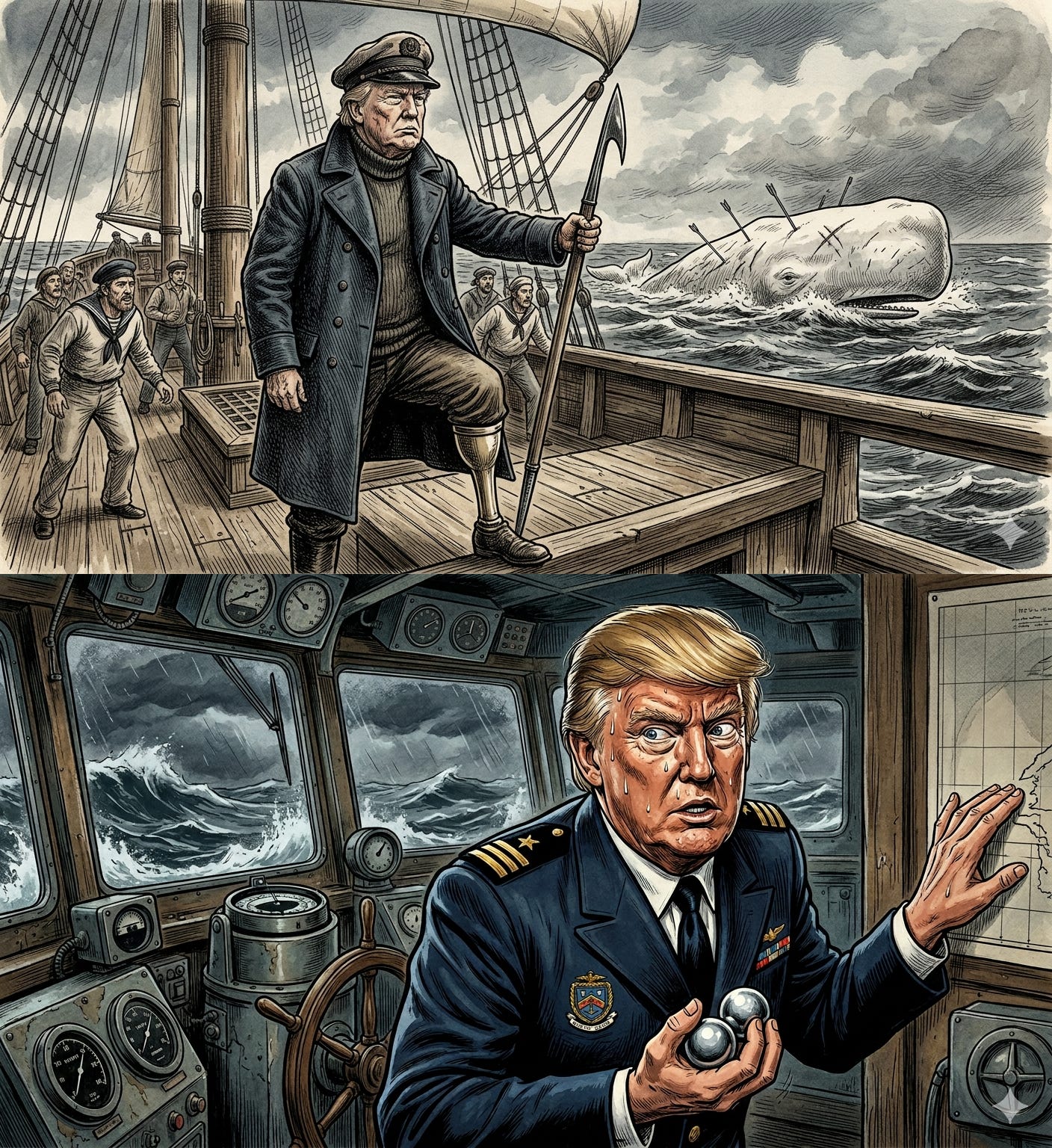
But somewhere between Richardson’s Ahab and the next day’s news cycle, another captain surfaced unbidden: Queeg. Captain Queeg, of Herman Wouk’s The Caine Mutiny — with his steel ball bearings, his stolen strawberries, his paranoid certainty that the crew was conspiring against him. And suddenly it became clear that these weren’t competing comparisons. They were complementary ones. Ahab and Queeg illuminate entirely different dimensions of this presidency — and together, they tell a more complete story than either could alone.
Ahab: The President as Dark Prophet
Melville’s Ahab is a figure of terrible grandeur. He doesn’t merely want to kill the white whale — he needs to unmake it, to assert human will against an indifferent universe. When he nails the gold doubloon to the mast and declares the hunt, the crew doesn’t follow out of duty. They follow because he makes the chase feel meaningful — because he transforms a commercial voyage into a crusade.
This is Trump at the rallies, Trump as movement. The MAGA phenomenon has always carried the quality of a doomed and glorious pursuit — a sense that something vast and corrupt must be harpooned and dragged into the light. His supporters don’t merely prefer his policies. They experience his political project as a calling. That is Ahab’s gift: the ability to make obsession feel like destiny.
Like Ahab, Trump is driven by wound and grievance. Ahab’s missing leg is his origin story — the whale took something that cannot be restored, and every subsequent action flows from that primal humiliation. Trump’s psychic wounds are similarly foundational: the mockery of elites, the 2011 White House Correspondents’ Dinner where Obama laughed at him openly, the four indictments, the civil judgments, the impeachments. He didn’t simply return to the White House. He returned like Ahab re-boarding the Pequod — older, angrier, the harpoon already raised. The second term is not a continuation. It is a reckoning.
Queeg: The President Behind Closed Doors
Step inside the actual machinery of governance, however, and a different literary figure comes into focus.
Captain Queeg is not grand. He is small — and that smallness is precisely what makes him dangerous. Where Ahab’s obsession is mythic, Queeg’s is bureaucratic and petty. He does not chase white whales. He investigates missing strawberries. He rolls steel ball bearings in his palm when the anxiety becomes too great to contain. He mistakes rigidity for strength, loyalty tests for leadership, and any whisper of disagreement for evidence of mutiny.
In the second term, the Queeg patterns have not moderated — they have accelerated. The mass dismissal of inspectors general in the administration’s opening days was not a policy decision. It was Queeg searching the enlisted men’s quarters for strawberry thieves, eliminating anyone positioned to observe and record. The purge of senior military officers — including the Chairman of the Joint Chiefs — for insufficient displays of enthusiasm echoes Queeg relieving officers not for incompetence but for the crime of failing to mirror his own certainty back at him. The installation of loyalists at the Justice Department, the FBI, and the intelligence agencies follows the same logic: surround yourself with people who will not pick up the ball bearings and ask what they mean.
Wouk’s masterstroke with Queeg is that he was not entirely wrong. The crew did undermine him. The strawberries were stolen. His paranoia had real roots, which made him simultaneously pitiable and unmanageable. Trump’s institutional grievances, similarly, were not pure invention. The bureaucratic resistance was sometimes real. The media coverage was frequently hostile. This partial truth is what makes the Queeg dynamic so difficult to interrupt — the paranoia is anchored in something genuine, even as the response to it becomes increasingly untethered from proportion, reality or law.
The Keefers: They Thought They Could Manage Him
Here is where Wouk cuts deepest into the present moment — and where his most chilling character steps forward.
Tom Keefer is the intellectual of the Caine. Eloquent, sophisticated, and thoroughly cynical, he is the one who analyzes Queeg’s pathology with surgical precision, plants the idea of mutiny in receptive minds, and argues that men of conscience have a duty to act. And then, when consequences arrive, Keefer is nowhere to be found. He shaped the outcome. He avoided the cost. He is the novel’s true villain — not because he was wrong about Queeg, but because he used that correctness as leverage for his own advancement while others paid the price.
The second Trump term has its Keefers, and they are not difficult to identify.
Marco Rubio once called Trump a “dangerous con man” unfit for the presidency. He is now Secretary of State, executing a foreign policy that has unnerved NATO allies, acquiesced to Russian positioning on Ukraine, and repositioned the United States away from the postwar alliance structures Rubio himself once championed. He did not change his mind. He changed his calculation.
JD Vance, who privately described Trump in the most extreme terms imaginable in 2016, is now Vice President — the designated heir of a movement he once viewed with open contempt. His conversion was not gradual or reluctant. It was strategic, total, and remarkably fast. Keefer would have recognized the maneuver immediately.
Pete Hegseth, installed as Secretary of Defense despite no executive or senior military experience, understood from the outset that the credential required for this job was not competence but devotion. He had auditioned for the role publicly, on television, for years — performing loyalty at volume, attacking the military’s professional leadership as corrupted by weakness and ideology. He was rewarded not despite the absence of qualifications but because of it. An experienced Defense Secretary brings institutional loyalty, professional networks, and an independent conception of the national interest. Hegseth brings none of those complications. He is Keefer stripped of even the pretense of analytical sophistication — pure useful instrument, placed precisely where instruments are needed most.
Elon Musk, who endorsed Trump after years of political ambivalence, was rewarded with operational authority over DOGE — the so-called Department of Government Efficiency — granting a private citizen with vast federal contracts the power to restructure the workforce of the government that regulates him. The conflicts of interest are not incidental. They are the point. Musk is not managing Trump; he purchased proximity to power and is now extracting value from it in real time, at scale, with the enthusiastic cooperation of the administration. This is Keefer with a space program and an unbroken attention span.
And then there is the Senate. Republican senators who condemned January 6th in real time, who voted to convict or privately urged conviction, have largely resolved their discomfort through silence, accommodation, or active cooperation. The oversight capacity that defines the Senate’s constitutional role has been quietly folded and put away. These are not Starbucks — Melville’s first mate who knew the hunt was madness and said so, however ineffectually. They are Keefers: people who understand the situation with precision and have concluded that understanding it carries no particular obligation to act on that understanding.
Barney Greenwald’s Toast
Wouk reserves his sharpest blade for the novel’s final scene. Barney Greenwald — the lawyer who successfully defended the mutineers — delivers a devastating toast at the victory party. He is not celebrating. He is indicting. His argument is aimed not at Queeg but at the men who used him: you saw what he was, and instead of acting with integrity, you maneuvered around him for your own purposes, and called it conscience.
That speech is not yet being delivered in Washington. But it is being written.
The difference between the first term and the second is the difference between a Queeg who still had functioning officers around him and one who has systematically replaced them. In the first term, James Mattis resigned rather than execute orders he considered illegal. Rex Tillerson reportedly called Trump a moron and remained anyway, believing his presence was the guardrail. John Kelly, John Bolton, Mark Milley — each a flawed Starbuck, each eventually gone, each replaced by someone more willing to say yes. The Caine has been re-crewed. The officers who remain are not there despite their willingness to comply. They are there because of it.
The Ship Keeps Sailing
Ahab explains the movement. Queeg explains the administration. Together they describe a presidency operating simultaneously on two registers — mythic and petty, visionary and paranoid, capable of genuine mass force and strangely, dangerously small in its daily exercise of power.
The rallies are Ahab. The governance is the Caine.
Both Melville and Wouk arrived at the same dark conclusion: the captain is dangerous, but the real vulnerability is the ship. It is crewed by people who know better, who see what is happening, and who — for reasons of loyalty, ambition, fear, or cold calculation — keep sailing anyway.
Heather Cox Richardson was right to reach for Ahab. But Queeg was waiting in the wings, rolling his ball bearings, absolutely certain that someone had taken his strawberries.
The Keefers are in the cabinet now.
And the ship keeps sailing.
FTS
Join us on our podcast Specifically for Seniors, where satire meets substance and storytelling sparks civic engagement. Each episode dives into topics like authoritarianism, political spectacle, environmental justice, humor, history and even fly fishing and more—layered with metaphor, wit, and historical insight. We feature compelling guest interviews that challenge, inspire, and empower, especially for senior audiences and civic storytellers. Listen to the audio on all major podcast platforms, watch full video episodes on YouTube, or explore more at our website.
Let’s keep the conversation sharp, smart, and unapologetically bold