The Republic We Were Promised
Part One of Five: What 250 Years Actually Looks Like
Word count: 1,298 | Estimated reading time: 5 minutes
There is a celebration being planned for this summer that will cost tens of millions of dollars, feature military flyovers and a fireworks display visible from space, and be attended by a man who has pardoned the people who beat police officers with American flags while trying to prevent the peaceful transfer of power.
They are calling it a celebration of American freedom.
We should talk about that word. Freedom. And about what 250 years of this republic actually means — not as a backdrop for a strongman’s pageant, but as a living argument, unfinished and hard-won, that the people assembled to watch the fireworks are in some danger of losing.
This is the first installment of a five-part series. It is not a series about Donald Trump, exactly. It is a series about what happens to a republic’s immune system when enough of its antibodies stop working simultaneously — when the courts retreat, when the Congress genuflects, when the cabinet keeps its head down, when the press is called the enemy of the people, and when the people themselves are asked to choose between their team and their country and some of them choose the team.
We begin with the birthday party, because it tells you almost everything.
What the Founders Actually Built — and Why It’s Harder Than It Looks
The men who gathered in Philadelphia in 1776, and again in 1787, were not demigods. They were lawyers and landowners, many of them slaveholders, all of them deeply suspicious of concentrated power because they had lived under it. They had read their Locke and their Montesquieu. They knew what kings did when no one stopped them.
So they built a machine designed to stop them.
The separation of powers — executive, legislative, judicial — was not an aesthetic choice. It was an engineering solution to a specific problem: human nature. Madison wrote in Federalist No. 51 that “if men were angels, no government would be necessary.” They were not angels. The Founders knew it because they were not angels themselves. The system was designed to function even when its operators were ambitious, self-interested, and occasionally corrupt — because it assumed they would be.
The machine has three moving parts, each designed to resist the others. Congress makes the laws. The president executes them. The courts interpret them. No one branch was meant to dominate. The health of the republic depends not on the virtue of any individual leader but on the friction between the branches — on the fact that ambition, as Madison put it, must be made to counteract ambition.
What the Founders could not fully anticipate was the scenario in which one political coalition captured multiple branches simultaneously and then used the rules of the system to insulate itself from the system’s correction mechanisms. They assumed the branches would jealously guard their own power. They did not fully account for a Congress that would surrender its power voluntarily, or a Supreme Court that would reinterpret the Constitution to grant a president immunity from accountability, or a cabinet that would invoke neither conscience nor the 25th Amendment regardless of what it witnessed.
They built a machine that required operators willing to run it. When the operators stop, the machine doesn’t fight back. It just stops.
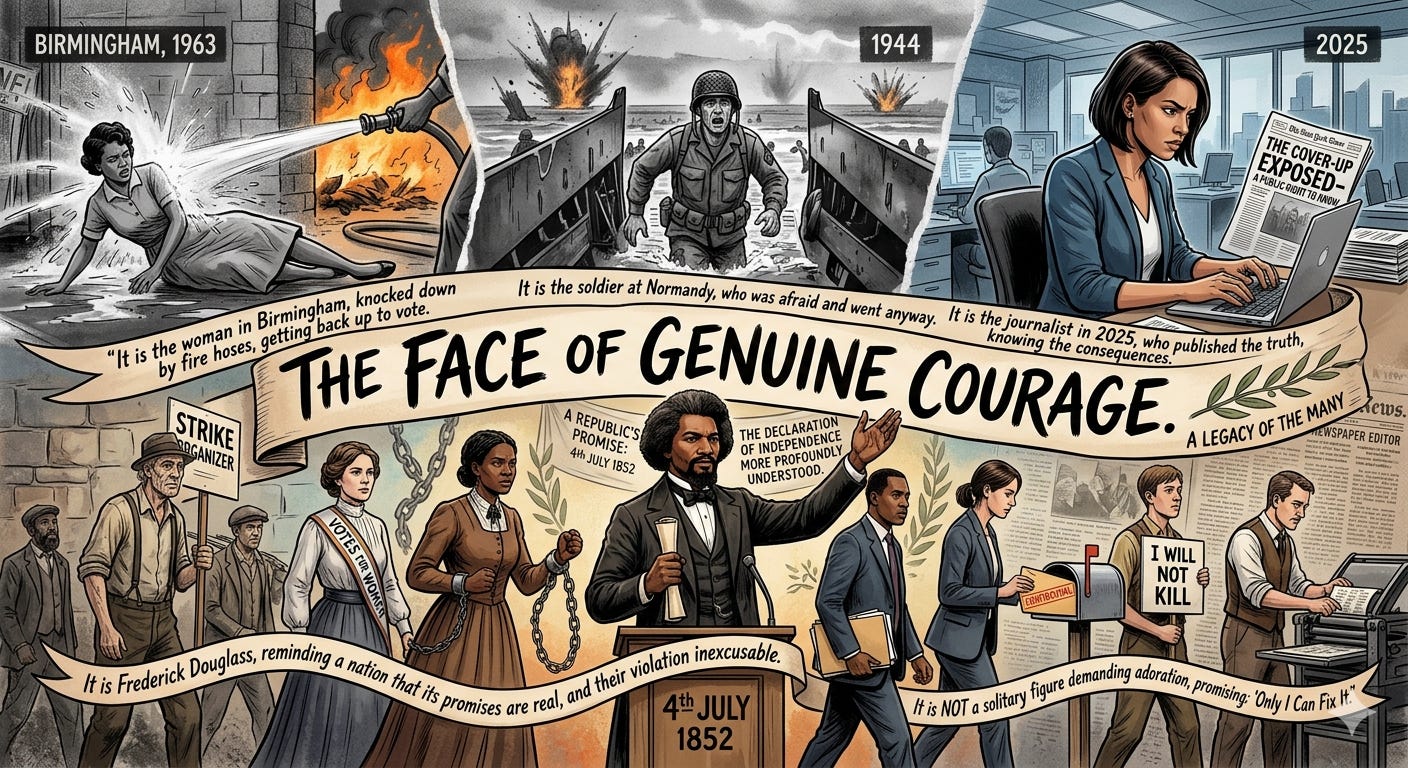
What 250 Years Actually Looks Like
It looks like a woman in Birmingham in 1963 who was knocked down by a fire hose for wanting to vote, and who got back up.
It looks like a soldier on a Normandy beach in 1944 who was afraid and went anyway.
It looks like a journalist in 2025 who published a story knowing it would bring consequences, because the story was true and the public needed to know it.
It looks like the labor organizer, the suffragist, the abolitionist, the civil rights lawyer, the whistleblower, the conscientious objector, the small-town newspaper editor who ran the piece anyway.
It looks like Frederick Douglass, who understood the Declaration of Independence more profoundly than most of the men who signed it, and said so, plainly and at great personal risk, at a Fourth of July celebration in 1852 — reminding his audience that the promises of the founding documents were real, which was precisely why their violation was so inexcusable.
It does not look like a man in a red cap standing in front of a military parade, telling the crowd that only he can fix it.
Democracies do not die all at once. They die in increments, each one defensible in isolation, each one slightly normalizing the next. The rally that was a little too aggressive. The norm that was broken with no consequences. The institution that looked away. The press conference at which the lie was not challenged. The election result that was questioned not on evidence but on preference. The crowd that cheered anyway.
Two hundred and fifty years is a long time. It is long enough to know that the republic has been in danger before — from without and from within — and that what saved it was never a single hero. It was always the aggregate weight of people who refused to look away, who kept showing up, who maintained the argument even when the argument was losing.
What This Series Will Argue
Over the next four installments, we will examine the specific mechanisms by which the republic’s immune system has been compromised — and what remains available to citizens who are paying attention.
We will look at the Supreme Court — at how a generation of strategic appointments produced a majority willing to grant the executive branch immunities the Founders would have found monarchical, and at what legitimate remedies remain.
We will look at Congress and the cabinet — at the 25th Amendment that exists on paper and nowhere else, at the specific human calculations that produce institutional cowardice, and at what it costs a democracy when its designated guardrails decide the personal price of guardrailing is too high.
We will look at the free press and independent writers — at why the coalition of voices that exists outside institutional media may be the most important civic actor of this moment, and at how those voices can be more than the sum of their parts.
And we will look at the voter — the most unglamorous and most powerful actor in this entire story — and at why the midterm primaries in November matter more than most people who should know better seem to understand.
A Note on Tone
This series will not pretend to be neutral on the question of whether democratic institutions matter. They do. That is not a partisan position. It is the foundational position without which no other political argument is possible.
It will try, however, to be honest about complexity — about the legitimate grievances that authoritarian movements exploit, about the failures of the institutions that were supposed to prevent this, about the ways in which all of us who believe in liberal democracy have sometimes failed to make that case persuasively to people who needed to hear it.
Outrage is easy. Analysis is harder. Both are necessary. What is most necessary is the combination — the kind of writing that makes you feel the urgency and understand the mechanism simultaneously.
That is what this series is trying to be.
The fireworks will be beautiful this summer. They always are.
The question is what we’re celebrating — and whether we’re willing to do what’s required to make sure there’s something left to celebrate at 300.
Next: Part Two — “The Court That Couldn’t” — How a politicized Supreme Court gave the executive branch immunity and what legitimate tools remain to address it.
FTS
Join us on our podcast the Enlightened Cynic, where satire meets substance and storytelling sparks civic engagement. Each episode dives into topics like authoritarianism, political spectacle, environmental justice, humor, history and even fly fishing and more—layered with metaphor, wit, and historical insight. We feature compelling guest interviews that challenge, inspire, and empower, especially for senior audiences and civic storytellers. Listen to the audio on all major podcast platforms, watch full video episodes on YouTube, or explore more at our website.
