The Silence of the Enablers
Part Three of Five: The Republic We Were Promised
Word count: 1,189 | Estimated reading time: 4.5 minutes
Section Four of the Twenty-Fifth Amendment to the Constitution of the United States reads, in its entirety, as follows: whenever the Vice President and a majority of either the principal officers of the executive departments or of such other body as Congress may by law provide, transmit to the President pro tempore of the Senate and the Speaker of the House of Representatives their written declaration that the President is unable to discharge the powers and duties of his office, the Vice President shall immediately assume the powers and duties of the office as Acting President.
It was ratified in 1967, in the aftermath of the Kennedy assassination, to address the practical question of presidential incapacity. But the language is broader than incapacity. “Unable to discharge the powers and duties of his office” is a capacious phrase. It has never been invoked by a cabinet against a sitting president. It almost certainly never will be, regardless of what a president does.
The question is why. And the answer tells you something important about how institutional cowardice works — and how it becomes indistinguishable, in practice, from complicity.
The Arithmetic of Self-Preservation
Start with the raw political calculation, because that is where most of the cabinet members start.
Invoking the 25th Amendment against a sitting president of your own party requires, at minimum, the Vice President and eight cabinet secretaries. It triggers an immediate constitutional crisis. It almost certainly ends the political career of everyone who signs the declaration. It subjects each signatory to the wrath of a president who has demonstrated, repeatedly, that he views loyalty as the supreme virtue and its absence as an unforgivable offense.
The people in those cabinet positions are not, for the most part, idealists. They are political survivors. They got where they are by calculating odds and managing risk. The calculation they face is straightforward: invoke the amendment and lose everything immediately, or stay quiet and retain influence, access, and the ability — or so they tell themselves — to moderate from within.
The “moderate from within” rationale deserves particular attention because it has been the stated justification of virtually every Republican official who has remained in proximity to this administration while privately acknowledging its excesses. It is also, the historical record now makes clear, almost entirely false. No one has moderated anything from within. What the rationale actually provides is cover — a story a person can tell themselves and their families about why they stayed, why they signed, why they nodded, why they said nothing.
John Kelly said it publicly after he left. James Mattis said it publicly after he left. Rex Tillerson said it publicly after he left. The pattern is consistent: silence while inside, candor while outside, and a political environment so thoroughly captured that the candor, once outside, changes almost nothing.
Congress and the Abdication of Article I
The Founders gave Congress formidable tools. The power of the purse. The power of oversight. The subpoena power. The treaty ratification power. The power to declare war. And, as the ultimate remedy, the power of impeachment.
Two impeachments have now been conducted. Neither resulted in conviction. The first, on the Ukraine phone call, failed when Republican senators calculated that the political cost of conviction outweighed the constitutional obligation. The second, on January 6th, failed when enough Republican senators determined — some explicitly — that a president who had already left office was beyond the Senate’s reach, a constitutional argument that most legal scholars found unpersuasive but that served its political purpose efficiently.
What the two impeachments demonstrated was not that impeachment doesn’t work. They demonstrated that impeachment requires a Senate willing to convict — and that a Senate whose members are individually afraid of primary challenges from the base of the president they are judging will not convict, regardless of the evidence.
This is the mechanism worth understanding: it is not that Republican senators privately believe Trump did nothing wrong. Many of them, in private, say otherwise. It is that the cost-benefit analysis of conviction — losing a primary, losing their seat, losing their career — outweighs the cost-benefit analysis of acquittal, which is merely historical judgment from people who don’t vote in Republican primaries.
Senator Mitch McConnell voted to acquit and then gave a floor speech making clear he believed Trump was morally responsible for January 6th. That combination — acquittal plus condemnation — is the perfect emblem of institutional cowardice. It is the behavior of a man who understood exactly what the moment required and chose, with full knowledge, to do something else.
What Institutional Cowardice Actually Costs
It costs more than most people who practice it calculate at the time.
The immediate cost is the lost check — the constraint that didn’t constrain, the accountability that didn’t account. But the longer cost is normative. Every time an institution fails to enforce its own rules, the rules become less real. Every time a senator votes to acquit on evidence he privately finds compelling, the impeachment process becomes less credible. Every time a cabinet secretary stays silent about what he witnesses, the 25th Amendment becomes more theoretical.
Norms are not self-enforcing. They exist because enough people in enough institutions behave as though they matter. When enough people stop, they stop mattering — and the next generation of political actors inherits a landscape in which the constraints are visibly weaker than they were before.
This is the compound interest of enabling. It accrues slowly and then all at once.
There have been exceptions. Liz Cheney. Adam Kinzinger. Mitt Romney. A handful of others who paid the price that institutional integrity requires and did it anyway. They are worth honoring — not because they saved anything, because they didn’t, but because they demonstrated that the choice was real. That there were Republicans who looked at the same calculation and reached a different answer.
The fact that they are largely gone from Republican politics is precisely the point.
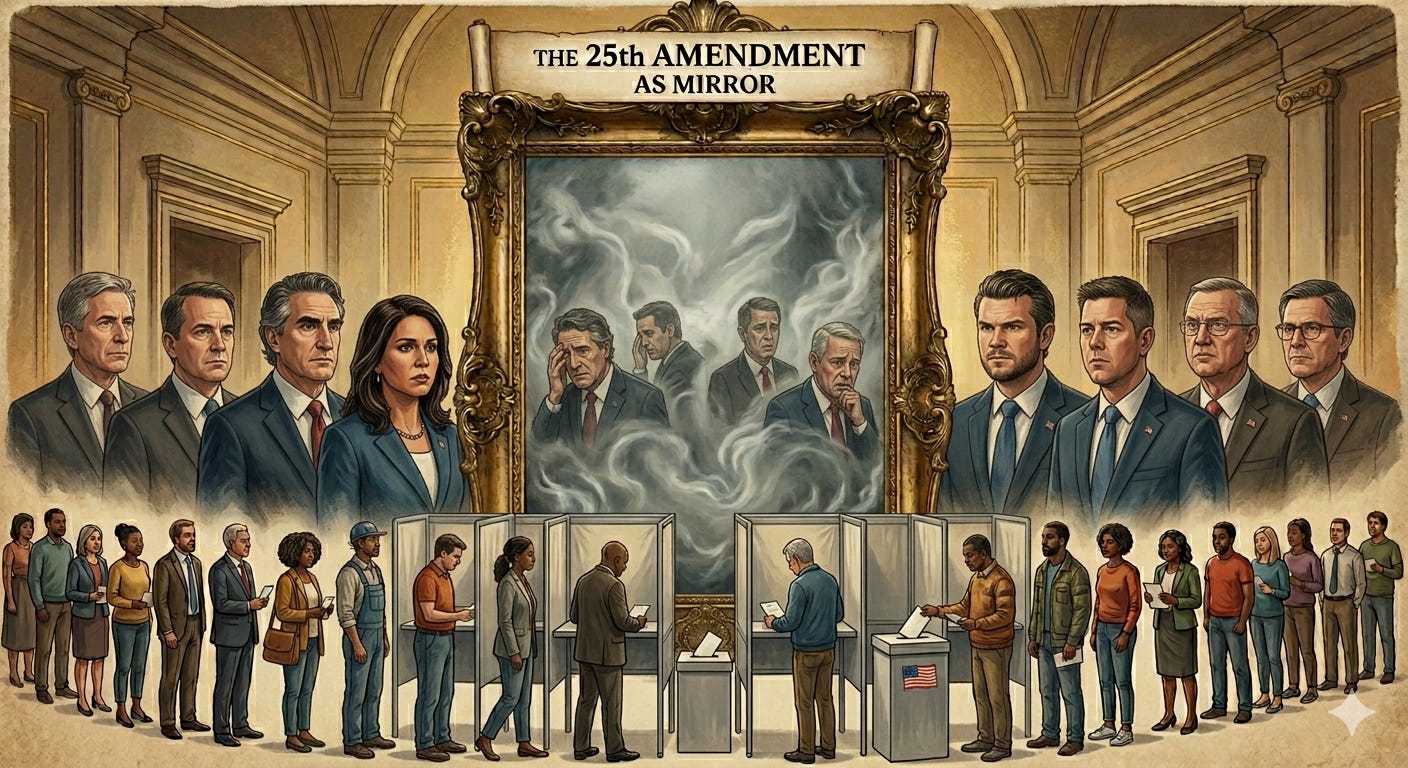
The 25th Amendment as Mirror
The amendment’s unused status is less an argument for its uselessness than a mirror held up to the people who could invoke it. The mechanism works. The political will to use it does not exist. Those are different problems with different solutions.
The solution to a cabinet that won’t act is a different cabinet — which requires a different president, which requires elections. The solution to a Senate that won’t convict is a different Senate — which also requires elections. The solution to a Congress that has surrendered its Article I authority to an executive branch that has aggressively expanded its own is a Congress with members who want their power back — which also requires elections.
Everything, ultimately, requires elections. Which is the least glamorous and most important conclusion available.
There is one other remedy that doesn’t require winning a federal election: the mobilization of civil society, the press, independent writers, and the organized citizenry to raise the political cost of silence high enough that the calculation changes. To make enabling more expensive than resisting.
That is not a constitutional mechanism. It is a social one. But social pressure is what moved the arc of American history in every moment when the formal institutions failed — and the formal institutions have, historically, failed more often than the civics textbooks acknowledge.
The enablers are not a fixed fact of nature. They are people making calculations. Change the inputs, and the calculation changes.
The question is who changes the inputs, and how.
Next: Part Four — “The Coalition of the Willing” — Why independent writers, journalists, and thinkers may be the most important civic actors of this moment, and how they can be more than the sum of their parts.
FTS
Join us on our podcast the Enlightened Cynic, where satire meets substance and storytelling sparks civic engagement. Each episode dives into topics like authoritarianism, political spectacle, environmental justice, humor, history and even fly fishing and more—layered with metaphor, wit, and historical insight. We feature compelling guest interviews that challenge, inspire, and empower, especially for senior audiences and civic storytellers. Listen to the audio on all major podcast platforms, watch full video episodes on YouTube, or explore more at our website.
