Unfit for Command
WORD COUNT1,847 READING TIME~9 minutes
Author’s Note and Disclaimer: This article is based on the opinion of the author and is intended to be an argumentative essay not a factually documented article. As such the article may exaggerate, conjoin facts and supposition, or interpret some of the actual facts and statements erroneously.
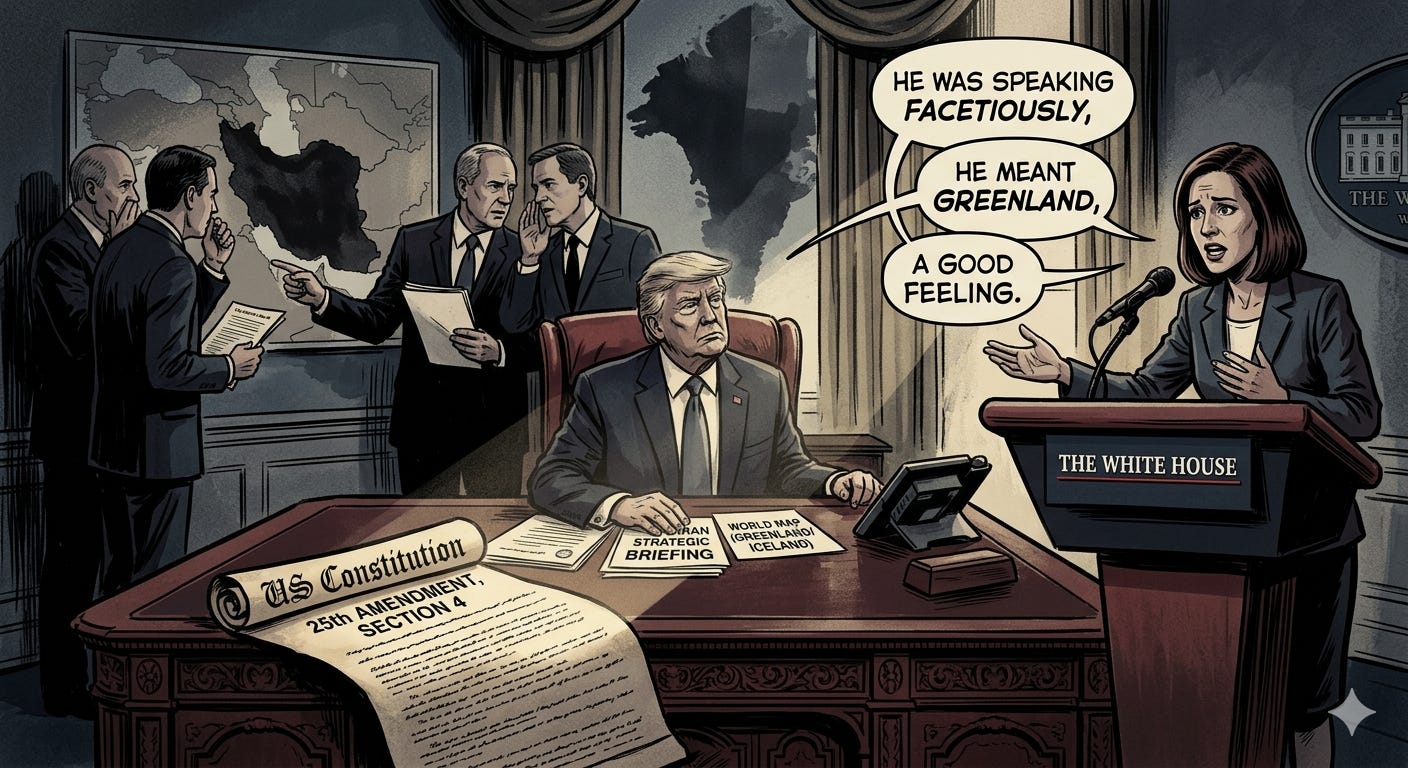
The 25th Amendment to the United States Constitution exists for a simple reason: there must be a mechanism to protect the republic when a president is unable to discharge the powers and duties of his office. Its framers did not require the president to be comatose, institutionalized, or visibly deranged. They required only that he be genuinely unable to govern. On the evidence now before the American public — documented, sworn, and in many cases captured on video — Donald Trump meets that standard.
This article presents three interlocking bodies of evidence: the systematic pattern of his press secretary contradicting his public statements; a documented record of cognitive and behavioral failures that go far beyond political disagreement; and the conduct of a war launched, in the words of that same press secretary, on a presidential “good feeling.” Together, they constitute the most serious constitutional case for Section 4 of the 25th Amendment in American history.
A president whose words must be constantly corrected by staff is not governing. He is being governed around.
SECTION I
When the Press Secretary Becomes the Interpreter-in-Cbief
Every presidential administration employs a press secretary to communicate and elaborate on the president’s positions. What no administration is supposed to require is a press secretary who routinely overrides, contradicts, and effectively nullifies what the president has just said. That is not communication. That is damage control — and it has become the defining feature of the Trump White House’s daily operations.
THE ELECTIONS THAT WERE ‘FACETIOUS’
Trump twice told Republican lawmakers that they should cancel the 2026 midterm elections. “We shouldn’t even have an election,” he said at one gathering; at another he told House Republicans, “I won’t say cancel the election, they should cancel the election.” Press secretary Karoline Leavitt subsequently informed the press corps that the President had been speaking “facetiously.”[1] She offered no evidence for this characterization. Trump did not clarify it himself. He had said what he said, in a closed meeting with lawmakers, twice.
THE GREENLAND CONFUSION
At the World Economic Forum in Davos — the centerpiece of Trump’s most prominent foreign policy initiative — Trump referred to Greenland as “Iceland” four separate times.[2] When a reporter noted the error, Leavitt took to social media to insist Trump had said no such thing, claiming it was the reporter who was confused: “No he didn’t, Libby. His written remarks referred to Greenland as a ‘piece of ice’ because that’s what it is.”[3] A community note was swiftly appended to her post, disputing her account. More damaging still: Secretary of State Marco Rubio then testified before the Senate Foreign Relations Committee that the president had simply misspoken — “He meant to say Greenland” — directly contradicting his own press secretary about what the president had said at a major international forum.[4]
NATIONALIZING ELECTIONS — WHO WAS RIGHT?
When Trump told a podcast host that Republicans should “take over” elections, Leavitt explained this referred narrowly to the SAVE Act. Trump then contradicted her directly, clarifying he had meant something quite different. As one analyst noted, “Trump’s top spokesperson said he meant one thing, and that turned out not to be true. If nothing else, it’s a huge mark against a spokesperson’s credibility — their job is to quite literally speak for the president.”[5]
The constitutional significance of this pattern cannot be overstated. A press secretary holds no constitutional office. She commands no branch of government. She has no legal authority to determine what the president meant. When her interpretations are wrong — and in multiple documented cases they have been proven wrong by Trump himself or by senior Cabinet officials — the result is an executive branch speaking in three contradictory voices simultaneously. Foreign allies, military commanders, and the American public cannot know what the President of the United States actually intends. That is not a communication problem. It is a governing problem.
SECTION II
A Documented Record of Cognitive and Behavioral Failure
Isolated misstatements are the currency of political life. What follows is not a list of isolated misstatements. It is a pattern — longitudinal, documented, and in several cases confirmed by Trump’s own appointees — of failures that go directly to the question of presidential capacity.
NIKKI HALEY AND JANUARY 6TH
At a campaign rally in Concord, New Hampshire, Trump repeatedly blamed Nikki Haley for the security failures of January 6, 2021 — an event at which Haley held no office and bore no responsibility.[6] That responsibility lay with Nancy Pelosi as House Speaker. Haley responded publicly: “I wasn’t even in D.C. on January 6. I wasn’t in office then... The concern I have is — when you’re dealing with the pressures of the presidency, we can’t have someone else that we question whether they’re mentally fit to do this.”[6] Trump’s defense was that the confusion was deliberate — a rhetorical device. He offered the same justification for his repeated confusion of Biden with Obama. The claim that a sitting president is intentionally misattributing the most serious domestic crisis of his first term — as a joke — does not resolve the concern. It compounds it.
JOAN RIVERS AND THE IMPOSSIBLE CONVERSATION
On June 14, 2024, Trump recounted a conversation in which his longtime acquaintance Joan Rivers told him she had voted for him in the 2016 election.[7] Joan Rivers died in September 2014 — two years before that election. This is not a slip of a name or a date. It is a fabricated memory: specific, detailed, and impossible.
VIKTOR ORBÁN, LEADER OF TURKEY
Trump referred to Hungarian Prime Minister Viktor Orbán — one of the world leaders he praises most publicly and frequently — as the leader of Turkey.[8] Confusing Orbán, whom Trump has repeatedly cited as a model of governance, with the leader of an entirely different country is not a slip of the tongue. It suggests a disconnect between name and associated knowledge that goes beyond momentary confusion.
THE DEMENTIA TEST HE CANNOT IDENTIFY
Trump has on multiple occasions boasted about passing a cognitive assessment, describing it as “a very hard test for a lot of people. It wasn’t hard for me.”[9] The test he describes is the Montreal Cognitive Assessment — a brief dementia screening designed to detect cognitive impairment, not measure intelligence. Medical experts and the test’s own creators have repeatedly noted this distinction. As recently as March 27, 2026 — three days before this article was published — Trump told his Cabinet he had taken this test three times while visibly struggling to keep his eyes open during the meeting.[10] The irony is not subtle: a president bragging about passing a dementia screening while demonstrating he cannot accurately identify what the test is, delivered while apparently fighting to stay awake in a Cabinet session.
THE LINGUISTIC BASELINE
Experts who have studied Trump’s speech longitudinally document a measurable decline from his baseline in the 1990s, when he spoke in complete paragraphs and sustained coherent arguments. Today specialists observe what they describe as severe language problems: inability to complete sentences, frequent tangential wandering, and phonemic paraphasic errors — the substitution of incorrect sounds for intended words.[11] A linguistic analysis found a 13 percent increase in all-or-nothing language, a 69 percent increase in profanity, and a 32 percent higher ratio of negative to positive words compared to 2016.[12]The neurology community has noted that these patterns — alongside behavioral disinhibition and increased impulsivity — are consistent with cognitive decline from an established baseline.
A president who fabricates conversations with the dead and cannot name the world leader he most frequently praises is not having a bad day. He is showing us who he has become.
SECTION III
The Iran War: A “Good Feeling” and a Constitutional Crisis
If the first two sections establish a pattern of cognitive and communicative failure, the Iran war transforms that pattern from a domestic political concern into a matter of life, death, and national survival.
HOW THE WAR BEGAN
The United States launched military strikes against Iran during active nuclear negotiations, killing Iran’s Supreme Leader and other officials.[13] Trump did not seek Congressional authorization. He did not make a public case to the American people. He did not meaningfully consult NATO allies, most of whom learned of the strikes after they had begun. His administration subsequently offered at least six mutually contradictory justifications: preventing an imminent attack; pre-empting Iran’s nuclear program; securing Iran’s natural resources; enabling regime change; protecting US forces; and responding to Iranian aggression.[14] These are not variations of the same argument. They are six different wars. The administration has been unable to settle on which one it is fighting.
A ‘GOOD FEELING’
Secretary of State Marco Rubio told reporters the administration had launched a pre-emptive strike because it believed Iran was about to retaliate against US forces. Trump then contradicted Rubio, offering a different chronology entirely. Leavitt, interpreting both men, told the press that the president had simply had a “good feeling” that Iran would strike — so Washington attacked Tehran.[15] The United States went to war against a sovereign nation, during active peace negotiations, without Congressional authorization — and the most coherent explanation produced by the White House was that the commander-in-chief had a feeling.
HE WAS WARNED — THEN CLAIMED NOBODY HAD WARNED HIM
After Iran retaliated by striking US allies across the Gulf region, Trump stated publicly — twice, in one day — that the retaliation had been completely unexpected. “They weren’t supposed to go after all these other countries,” he said. Asked whether he had been briefed on this possibility beforehand, he replied: “Nobody, nobody, no, no, no.”[16]
This statement has since been directly contradicted by sworn Congressional testimony from his own intelligence chiefs. Director of National Intelligence Tulsi Gabbard and CIA Director John Ratcliffe both testified that pre-war intelligence assessments warned that Iran would likely retaliate against energy sites in the Gulf and threaten the Strait of Hormuz.[17] Reuters separately reported that Trump was explicitly briefed on this scenario before authorizing the strikes. He was told. He was warned. He then told the American public and the world that nobody had predicted what his own intelligence community had predicted in writing.
There are only two possible explanations. Either Trump received the briefings and cannot remember or process their content — a profound cognitive failure in the most consequential decision a president can make. Or he understood the briefings, proceeded regardless, and is deliberately lying about having been warned. Neither possibility is consistent with the ability to discharge the duties of the office.
“I WON’T USE THE WORD ‘WAR’ “
Perhaps the most remarkable — and most constitutionally self-incriminating — moment of the entire Iran conflict came on March 25, 2026, when Trump addressed Republican lawmakers at a fundraising dinner and openly explained his own semantic strategy for evading the Constitution. "I won't use the word 'war,'" he told the crowd, "because they say if you use the word 'war,' that's maybe not a good thing to do. They don't like the word 'war' because you're supposed to get approval. So I use the word 'military operation.'" He elaborated further at a separate event: "It's for legal reasons — because as a military operation, I don't need any approvals. As a war, you're supposed to get approval from Congress, something like that. So I call it a military operation." A man who openly boasts about renaming a war to avoid legal consequences, while the same week declaring that war essentially over, while Iran continues striking US allies daily, is not executing a coherent legal or military strategy. He is narrating a version of events that exists primarily in his own mind — and doing so, on the evidence now before us, with diminishing awareness of the gap between that telling and the truth.
THE VICTORY THAT ISN’T
Throughout the conflict Trump has made statements about its progress that bear no relationship to observable reality. He declared that the US “has blown Iran off of the map” and that he had “met my own goals weeks ahead of schedule.” He told members of Congress that Iran “wants to make a deal so badly.” Iran’s foreign minister responded directly: “We never asked for a ceasefire, and we have never asked even for negotiation.”[18] As of March 29, 2026 — the day before publication — Trump said talks with Iran were going well and that Iran had agreed to most American demands. That same day, Iran’s parliament speaker rejected the ongoing negotiations entirely. Trump is describing a peace that does not exist, reporting agreements that the other party denies, and declaring victory over an enemy that continues to strike US allies daily.
CONCLUSION
The Constitutional Case, Stated Plainly
The 25th Amendment requires that a president be unable to discharge the powers and duties of his office. It does not require a formal medical diagnosis. It does not require the president to be unconscious. It requires evidence — and the evidence is now substantial, documented, and in several cases confirmed under oath by Trump’s own appointees.
The president cannot reliably identify living politicians. He fabricated a memory of a conversation with a woman who had been dead for two years. He confused the head of state he most publicly praises with the leader of a different country. He launched a war on, per his own press secretary, a “good feeling.” He was warned by his intelligence chiefs that Iran would retaliate against Gulf allies — and then publicly claimed nobody had warned him, a statement directly refuted by sworn Congressional testimony. He is describing a military victory and an ongoing negotiation that the other party says do not exist. And throughout all of this, his press secretary has been performing real-time interpretive surgery on his public statements — a function she has no constitutional authority to perform, and which she has gotten wrong repeatedly.
A former senior official who recently departed the administration said that internal gatekeeping had limited Trump’s access to dissenting views during the war. “A good deal of key decision-makers were not allowed to come express their opinion to the president.” This is the scenario the framers of the 25th Amendment feared most: not a president who is visibly, obviously incapacitated, but one who appears to be governing while those around him manage, filter, and compensate for a capacity that is no longer fully there.
He is not discharging the powers and duties of his office. He is occupying it.
The political will to invoke Section 4 does not currently exist. The Vice President and Cabinet who would need to act are his own appointees, operating inside a political coalition that has shown no appetite for self-correction. That is a political reality. It does not alter the constitutional reality.
The 25th Amendment was written for this. The question before the republic is not whether the case exists. It is whether anyone with the authority to act on it has the courage to do so.
SOURCES & REFERENCES
Trump suggests canceling 2026 midterm elections — White House calls it “facetious”Various news outlets including Axios and Politico, February 2026 Reported February 2026
Karoline Leavitt falsely claims Trump didn’t mix up Iceland and Greenland in Davos speechYahoo News / Associated Press January 21, 2026
Karoline Leavitt Issues Brazen Denial of Trump Iceland-Greenland Flub Heard Round the WorldMediaite January 22, 2026
Rubio contradicts Leavitt on Trump’s ‘Iceland’ remarks in Davos: ‘He meant to say Greenland’The Hill January 28, 2026
Trump contradicts Leavitt on election nationalization remarks; analyst commentary on press secretary credibilityMultiple outlets, February 2026 Reported February 2026
Trump blames Nikki Haley for January 6 security failures; Haley responds publiclyCNN, NBC News, multiple outlets Reported January 2024
Trump claims Joan Rivers voted for him in 2016 — Rivers died in 2014PolitiFact, multiple fact-checkers June 14, 2024
Trump refers to Viktor Orbán as leader of TurkeyMultiple outlets including The Guardian, Reuters Reported 2025
Trump repeatedly boasts about passing Montreal Cognitive Assessment, mischaracterizes it as intelligence testMedical community analysis; multiple press conferences Ongoing, 2024–2026
Trump tells Cabinet he has taken cognitive test three times; appears to struggle staying awakeWhite House pool reports; C-SPAN footage March 27, 2026
Expert analysis of Trump’s cognitive decline: phonemic paraphasic errors, language deterioration from baselineDuty to Warn; peer-reviewed linguistic analyses Ongoing, 2023–2026
Linguistic analysis of Trump rally speeches: 13% increase in all-or-nothing terms, 69% increase in profanity vs. 2016 baselinePublished academic linguistic analysis 2024–2025
US-Israeli strikes on Iran launched during active nuclear negotiations; Supreme Leader killedReuters, Associated Press, New York Times February 28, 2026
Trump administration offers six contradictory justifications for Iran war; CNN reporting on overstated Iranian threatCNN, Washington Post, Al Jazeera March 2026
Leavitt says Trump had a “good feeling” Iran would strike; Rubio’s prior explanation contradicted by TrumpAl Jazeera, Reuters, multiple outlets March 2026
Trump claims Iran’s retaliation against Gulf states was unexpected: “Nobody, nobody, no, no, no”Reuters, Associated Press; video of White House remarks March 2026
DNI Gabbard and CIA Director Ratcliffe testify Trump was briefed that Iran would likely retaliate against Gulf energy sitesCongressional testimony; Reuters March 2026
Iran’s foreign minister: “We never asked for a ceasefire”; Iran parliament speaker rejects negotiations Trump described as ongoingReuters, BBC, Al Jazeera March 29, 2026
Trump’s ‘Military Operation’ Wordplay Can’t Hide Iran War: Reason March 30, 2026
All claims in this article are drawn from documented public statements, sworn Congressional testimony, and reporting by major accredited news organizations.
FTS
Join us on our podcast Specifically for Seniors, where satire meets substance and storytelling sparks civic engagement. Each episode dives into topics like authoritarianism, political spectacle, environmental justice, humor, history and even fly fishing and more—layered with metaphor, wit, and historical insight. We feature compelling guest interviews that challenge, inspire, and empower, especially for senior audiences and civic storytellers. Listen to the audio on all major podcast platforms, watch full video episodes on YouTube, or explore more at our website.
Let’s keep the conversation sharp, smart, and unapologetically bold